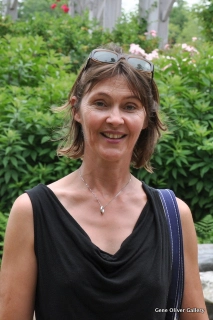
Meet My Character Blog Tour


L1010996

Last week, a fellow blogger invited me to be part of Meet My Character Blog Tour.

Sherri blogs and writes from England, her native land, after many years spent in California. Although she didn’t have to learn a new language, she had to adjust to a new lifestyle as she raised her children in the Golden State.

I also live in California, away from my native France. This common characteristic established a natural bond between Sherri and me. Although we’ve never met and communicate only through our blogs, I’ve learned a lot about Sherri and the challenges of her life, thanks to her regular posts and gorgeous photos. She is now at work on a memoir.

Thank you, Sherri, for thinking of me for this event.

It’s now my turn to tell you about Cameron, the main character of my novel Trapped in Paris (for readers 12 and up).

1. What is the name of your character? Is he/she fictional or a historic person?

Cameron is the main character in my novel. He’s sixteen, American, and the product of my imagination.

2. When and where is the story set?

The story is set in Paris and the Parisian suburbs in April 2010 when a volcano erupted in Iceland, disturbing air transportation through most of the world for days and even weeks.

3. What should we know about him/her?

Cameron lives in Portland, Maine. His father owns a small float of fishing boats and expects Cameron to work with him someday.

Cameron is the middle child of five and also the only boy, which gives him a good understanding of girls and a natural respect for them.

Cameron is close to his mother, a third-grade teacher, and to his fifteen-year-old sister Maddie.  He also adores his eight-year-old sister Rose.

4. What is the main conflict? What messes up his/her life?

Cameron’s girlfriend Lilley has dumped him brutally for another boy. This recent broke-up episode adds to Cameron’s natural prudence.

He has never told his father that he’s scared of the ocean and that he doesn’t want to be a fisherman. Although he has never traveled away from his native state, Cameron’s curious about the world. So when his High School’s French Club plans a trip to Paris over spring break, he wants to go. Still heartbroken, he doesn’t want to fall in love ever again.

So when he’s stuck at the Paris airport when the volcano erupts, he wants to stay away from Framboise, a girl he meets there. Yet this girl’s different from his former girlfriend,  intriguing and convincing, and when she suggests to leave the airport for Paris, Cameron gives in.

When he and Framboise witness a crime on the River Seine, they are kidnapped by a dangerous man and kept in an empty flat. From that moment, the two of them will become unlikely partners in a fast, action-packed four-day adventure through the Parisian suburbs.

5. What is the personal goal of the character?

For the first time, Cameron is confronted to several new, important experiences.

He fell in love and a girl broke his heart.

He’s miles away from home.

He’s stuck in a foreign airport.

He meets Framboise, a girl who speaks three languages, has traveled the world, and is adventurous.

He will have to rely on Framboise while he wants to stay away from girls.

He will also have to trust his survival instinct, brave danger, and act with courage to help Framboise when the two of them get separated.

Ultimately Cameron will learn to believe in himself.

6. Is there a working title for this novel, and can we read more about it?

When I started this story, a title jumped to my mind: Ash Cloud.

I thought it would be the final title until a writing friend told me that Ash Cloud was misleading. My husband shared the same opinion, so I reconsidered. Changing the working title wasn’t easy, but ultimately I agreed that the volcano eruption triggers the story but isn’t the main topic.

The final title Trapped in Paris is the product of a brainstorming session between my husband and me.

7. When can we expect the book to be published?

I published the novel in the fall 2012. It’s available through Amazon and can be ordered in any bookstore.

Last fall, I teamed up with the same editor for a new novel that will hopefully be available before the end of 2014. In addition, I have two other completed manuscripts that I intend to publish as well. I have also recently submitted a short story to a French publishing company for an anthology.

A Petunia's Place, samedi 26 novembre 2012

At Petunia’s Place, November 26, 2012


I’m happy to return Sherri’s invitation and invite other writers on Meet My Character Blog Tour.

You’ll notice that the five of them are women. Nothing against men! Several men are among my favorite writers. And I also know terrific bloggers who are men.

I selected women to support the #ReadWomen2014 twitter initiative.

I owe the idea to Kimberly who wrote about it earlier this year.

The writers below are women I respect and admire.  Their writing and blogs inspire me. They make me feel good about being a woman and hopeful for a kinder world in which art would play a more active role.

L1010998

Listed in alphabetical order and not in order of preference, using the blogs’ names:


Alvarado Frazier

Life Between the Sheets (of paper): Story, Art, and Poetry

Mona writes posts infused with poetry. In addition to her poems, Mona has completed a YA novel, now a quarter finalist in the Amazon Breakthrough novel. Cheers to her success!

I was drawn to Mona’s blog because of her American-Mexican heritage, and the fact that she’s using challenges and work experiences as powerful ingredients in her writing.

Harvesting Hecate

Thoughts on life, writing, creativity and magic

Andrea runs a high quality blog where I always read beautifully crafted posts and also find inspiration to fuel my own writing. Her posts about creativity are among my favorites.

Andrea’s writing has been noticed and recognized. Her list of awards and prizes is too long to list here.

Kimberly Sullivan

Thoughts on reading, writing, travels, and all things Italian

I could only be attracted to Kimberly’s blog. Kimberly was born in the US and lives now in Italy with her family. Besides her regular blog posts, Kimberly writes fiction. Many of her short stories have been published. I read Amica del cuore in the anthology Foreign and Far Away and liked it very much. Kimberly has completed two fiction novels.

Stella Tarakson

Author – children and young adults

I like Australian writers – Markus Zusak is my favorite – so when I met Stella who writes from Australia, I knew I would feel at home.

Through her extensive teaching and writing experience Stella provides concrete advice to recent and more seasoned writers. Some tips apply more specifically to Australian writers, but inspiration and support are international. Stella has already published many books. Some of them have received awards. Her latest book will be in print this year.

Teagan’s Books

Teagan Ríordáin Geneviene is one of the most unique and creative writers I’ve met online.

She writes fantasy fiction and started blogging when she embarked the indie boat to publish her novel Atonement, Tennessee.

As a personal practice exercise Teagan started a project called Three Ingredients. Using three cooking or baking ingredients, she concocts the most original posts, blending plot, characterization, and setting with the expertise of a chef. Et voilà! Due to her readers’ enthusiastic response, she’s at work on Cookbook 2.
L1010921

I hope you will take the time to visit these women writers to read more about their work, either published or in progress.


Still Writing…

L1010683


When AP testing will be done, finals over, high school graduation a memory, and summer vacation almost there, I will be visiting a local high school.

It will be so close to the end of the school year that I wished I could simply sit down with the kids, listen to their summer plans, ask them about the books they like, and the stories they would like to read.

In my perfect plot I would be a host.

But the school counselor and the AP English teacher have invited me to talk about writing.

It is not the first time I visit a school, a library, or a bookshop.

But in the past, my visit was linked to the recent publication of my novel, to a specific event, or in collaboration with other writers.

When I’ll go to that school I’ll be alone, and although I can bring copies of my book, the main purpose of my visit is to talk about the process of writing.

When you spend huge amounts of your time making up people, crafting twists and turns and ups and downs to create suspense, pondering one work over an other, don’t you think it’s a little weird to be invited to talk about this process?

Should I talk of the time I spent yesterday over chapter 21 of my new novel? Of the hard time I had to hush the racket playing in my head, so I could re-enter the world of my people? Of the fluttering inside me when I found my pace and ran to meet my main character’s expectations? Or of my disappointment when I had to click on Save because I had to pick up my son at school, while I would have loved to stay?

Who could be interested to know that?

Seriously, in a world that gives more importance to material possession than art, more power to the product than the journey to build it, more visibility to quick success than behind the scene labor, is it important to talk about writing?

But I’m invited and feel a greater responsibility than when I ask to come over.

In the same way considerate guests arrive with a bouquet of flowers or a bottle of wine when invited for dinner, I want to bring something special with me.

As I searched through my files and power presentations, I find that too much is about me, about my personal journey, and my work.

SAM_1422

I would like for the students to value words as exquisite and powerful artistic tools.

Words are what notes and instruments are to musicians, watercolors, oil, and brushes to visual artists, stone, glass, wood, and carving utensils to sculptors.

Our palette isn’t limitless but our possibilities infinite.

Like most writers did when they were teenagers, high school kids write to make sense of the complexity of their feelings and emotions, of their wounds and their moments of happiness, and also just for the fun of telling a story.


I would also like to be honest.

Writing, unlike some other jobs, is never perfect. This imperfection triggers moments of doubt. Is it worth of my time to sit for hours and write?

On the other hand, although most people but artists will find this strange, the richest aspect of writing, in my opinion, resides in its imperfection. I find the search for higher quality very rewarding.

When people find out that I write, some of them believe that writers are rich. I assume financially rich.

Some are such great and prolific writers that they sell lots of books and make money.

Many of us, however, will spend our lifetime without knowing this form of success.

Does it mean that we should stop writing?

Most writers have a day job and still write.

Not when we find the time to write but in the window of time that we’ve purposely designed for our writing.


I would also like more questions than answers.

SAM_0265

And I would really like to take a few people with me.


KCross for her upbeat attitude and marketing skills.

The Eye Dancers for his unique way to tie his writing to other forms of art.

Stella for her extensive writing and teaching expertise.

Mona for her work infused with poesy.


That would be a killer team.

In some ways, they will be there.

We write inspired by the authors who left their mark when we were young, and others when we became more sophisticated readers.

And we share our passion for words and stories, nourished by the passion of other writers.

photo(5)

What or who do you bring with you when you visit children or teens and are asked to talk about writing?

Junie B. Jones Is Still Alive

I never check my phone at 6 a.m., but a text from my daughter caught my eye.

“Barbara Park died.”

A little girl, cuddled on a sofa, deaf to her siblings playing nearby and to her mother’s call for dinner, because of a fictional character, is the best compliment for a writer.

Few adults are able to put themselves in the shoes of their six-year-old self.

Even less can write about what being six means.

Barbara Park did remember being six. She even said that she was six.

Junie B. Jones, the loud-mouthed first grader, wasn’t exactly a role model, and I met some teachers who didn’t like her that much. They found her challenging, I bet.

But to the kids she was a real kid. And they loved her.

When I cleaned my family library this winter, I kept many books from the time my children were very young. I couldn’t find the Junie B. Jones books.

Barbara Park kept Junie B. in first grade for years, before she moved her up a grade.

I wonder if she hasn’t gone to college.

My Sister and The Famous Five

I was told that I learned how to read watching my father turn the pages of L’Orne Combattante, one of the local newspapers published in my native Normandy.

I remember of the rough texture of his workpants against my small fingers when I gripped his leg to sit on his lap.

“Papa, what does it say? Tell me the story. Please, what is it?”

I remember that my father smelled of Gauloises cigarettes, masculine sweat, and cologne, while my mother smelled of coffee, French chalk, and eau de toilette.

My father drove trucks from Normandy to Paris every single day.

My mother was a seamstress working from home.

When my mother sewed, she listened to the radio.

When my father wasn’t driving, he read.

So it is possibly true that I learned how to read with my father.

I was also told that my paternal grandfather, blind by the time I was five, had been an avid reader. It is also possibly true since he encouraged my hunger for stories.

“Buy a book,” he would say, slipping crisp French bills or shiny coins in my hand for my birthday and Christmas.

I was six when I bought my first Club des Cinq books. I had no idea that The Famous Five series had been first written in English.

My favorite character was Claude; George in the original version. It was no coincidence that this girl had a unisex name.

In a world dominated by men, where girls who loved to climb trees and ride their bikes recklessly were called tomboys, Enid Blyton had created a girl who broke barriers and killed clichés. Claude/George was capable, smart, and witty: she was my dream friend and role model.

I grew up years away from Katniss and Tris, the strong female characters that inhabit contemporary YA literature. However, for the kid I was, The Famous Five, among other similar series, responded to the same urge for freedom and independence that I craved.

I remember stormy Thursday afternoons when there was no school. Wind slapped the shutters against the windows and rain pelted the roof while I read, my back propped against pillows, with the radio playing French and British songs and the humming of my mother’s sewing machine for background.

The occasional “Zut” that my mother uttered when she pricked her finger with a needle reached me through some kind of dreamy fog. Entangled in the story, she had to pull me away from “this darned book” while my sister focused her attention on strips of fabric that my mother didn’t use.

While she created clothes for her dolls and mini curtains for their houses made out of shoe boxes, my mind was in another world, caught up in solving a mystery that involved good and bad guys.

My sister didn’t like the fact that I refused to play with her when I was in the middle of a book. When I agreed, I invented games, which almost always involved two girls alone in the wilderness. We had to fight for food, for a roof, for protection. We had to fend for ourselves, away from the safety of the guest bedroom where our mother sewed. We were free from the rules of the adult world.

My sister didn’t like these game scenarios very much. Moreover she resented the time I spent with my books because she didn’t like to read.

And this is how I became a writer.

For the avid reader I was, my sister’s indifference toward stories and books was a mystery that I had to tackle.

When we are children we are afraid of the dark, of the school bully, of the creepy neighbor, and of being the only one who thinks crazy thoughts, but we are also fearless in the sense that failure hasn’t become yet a wounding word.

I figured that if my sister didn’t like to read she hadn’t found the right story. In my nine-year-old mind it was as simple as that.

This is how I wrote my first story.

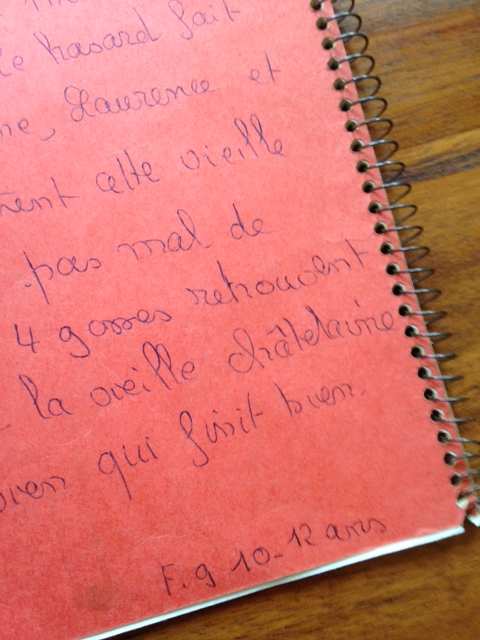
I wrote in two thin spiraled notebooks because I loved series. My sister had to get a book with two volumes.

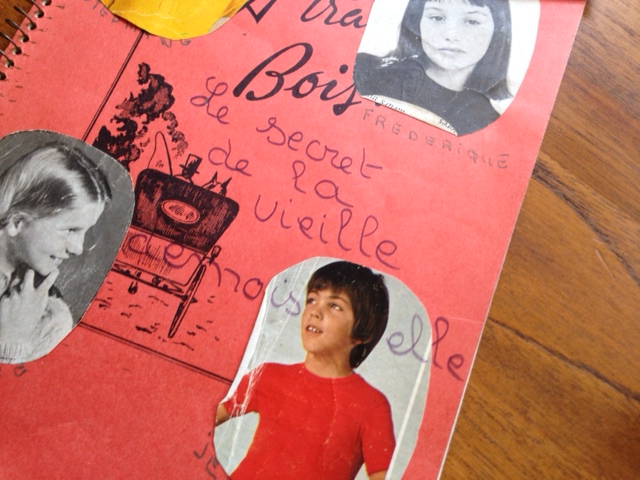
I cut out pictures from La Redoute and Les 3 Suisses – the French versions of the JC Penney catalogue and glued them on the cover. My sister had to get illustrated books.

photo-135

I mimicked the design of my beloved Enid Blyton’s books, including the ISBN and the readers’ age. My sister had to get legit books.

photo-133

My protagonists were two girls and two boys. The savviest was Frédérique, which is the female version of Frédéric; close enough to a unisex first name.

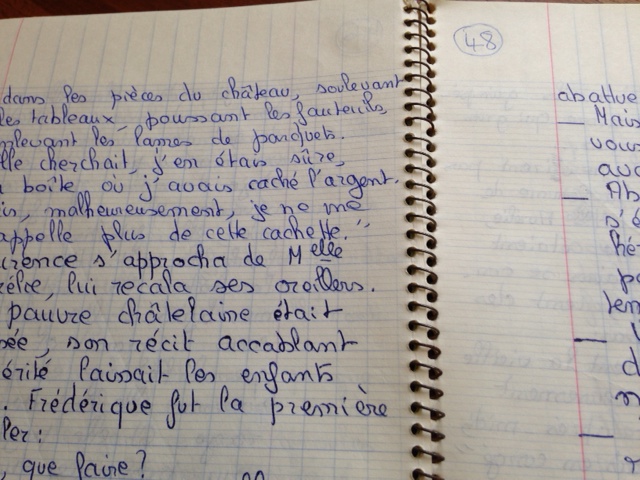
The plot was simple. A former rich old lady can’t remember where she hid her money in her dilapidated castle. Thanks to four smart kids the treasure is recovered after days of adventures.

Yes, the ingredients of my first story were similar to the ones Enid Blyton used for her successful plot recipe. The title mimicked hers too.

Le Secret de la Vieille Demoiselle (The Old Lady’s Secret), my first story, was followed by many more and also by poems as my discovery of writers and exploration of literary genres grew.

I was ravenous and never satiated, so like many people who love books I entered the publishing industry.

This is where I learned how books were made for real. This is also where I quit writing.

At least until I left Paris for California where, submersed by so many intense new experiences, I had no choice but write again.

In French first.

Then, years later, in English.


Over one recent summer, my sister and I got to spend more time together than we had for years. Our days in the company of each other in our parents’ home triggered long conversations punctuated by comfortable pauses that a common childhood allows.

Over countless espressos and late evening talks we shared lots of stories. Exactly twelve months separate my sister and me. Nothing now that we are adults. A whole world when we were children. Over these short but charged summer weeks, we were once more our parents’ children. And I was again the eldest.

This is why my sister was the one who spoke of the books I had written for her when she was eight.

“I still have them,” she said.

The following day she handed me Volume II.  “I’d like you to have it,” she said.

As a kid my sister had preferred Volume I. She had given a valuable lesson to her apprentice writer sister: the first chapter and even first lines of a story are very important if a writer wants to capture the limited attention of a reader.

“It could be fun for you to read your first French story,” my sister went on.


I had never re-read Le Secret de la Vieille Demoiselle.

When I flipped open the first page, my fingers cramped.

I wrote this story by hand, and in a Proust moment, this notebook triggered a rush of sensory and emotional memories.

photo-134

I remembered of tiredness when my hand clasped around my pen, of challenge, too, when I struggled with the plot. I was nine years old after all.

But the moments of pure joy when I found a word I liked, an idea to build more conflict, or simply when I forgot that I was a little girl and was instead a writer, were as vibrant as they were back then.

I read the story with affection and respect for the girl I was once. My childish words carried ideas, emotions, and tastes that are still mine.

When I closed the notebook, I remembered with equal affection of The Famous Five.

The first books that triggered my desire to write my first story were originally written in English, foreshadowing my future life in a country where I would someday learn how to write in English.


The Season of Creativity

This winter has been exceptionally cold in many parts of the States, so cold in fact that the words polar vortex will, from now on, describe arctic like winters. Miserable for the people, these icy days offered gorgeous winter photos opportunities.

Instead of frigid temperatures many Europeans countries have survived rainfalls that turned into legendary floods.

Ask anyone from the United Kingdom and from my native France. They were ready to build a new Noah’s Ark.

After such winters, the expectation for spring is high and almost palpable.

I feel it through the posts that land in my inbox.

Clean as a freshly plowed piece of land, hopeful as a calf standing up, promising as the first daffodils, these blog posts carry the signs of change and hope.

In the end, spring is all about the awakening of nature.

More subtle here in California, spring is sometimes so fugitive than most people will tell you that we have one rainy and one dry seasons.

The geography of a new country is rarely considered to be a destabilizing factor in the life of an immigrant.

And yet the decoding of the American landscape, its vastness and brutal weather patterns in comparison to France, have been for me as challenging and fascinating as the discovery of a new culture and the acquisition of a new language.

This year winter came early in the Sierra, accompanied by unusual November snowstorms that we misinterpreted for an upcoming rainy season.

L1000847

In fact, this winter has been very dry, and drought has a mean paw.

Premature life.

photo-84

Premature death.

photo-132

Although Yosemite has received very little precipitation, Glacier Road and Tioga Pass, the two roads that give access to the most interesting parts of the park, are still closed. So while the energy of spring bounces off blogs, I tame my impatience until my next hike in the high country.

SAM_0278

Spring, associated with un-cluttering, cleaning, and cleansing, is also a time of evaluation for artists and writers.

Mixed reviews accompany the assessment of my personal winter writing.

I am a winter child, born late in the year, and I do my best work during the short, dark days of winter. When winter has only been a word on the calendar I feel cheated.

The publication of my middle grade novel is delayed, mostly because of jobs’ obligations that stole more time and energy that I had anticipated, but also because I never felt quite anchored to the season.

Now that I reflect on the impact of seasons on human creativity, I am less surprised that it took me time to choose a title for this novel. In the end it is not coincidental that I decided on A Year in Château Roche.

Despite the absence of winter and an elusive spring in California, summer will come. This year, for the first time ever, all of my children will be studying and working away from home during the months of July and August.

This realization fills me with unexpected hope.

Could the long, sunny days of summer replace the short, dark days of a missed winter?

Now, tell me…

Did you take advantage of snow days to work on specific projects or has this unusual winter had a toll on your creativity?

Do seasons impact your creative work and your life in general?

In Honor of Dr. Seuss

In a recent attempt to organize our crowded family bookshelves, I’ve spent delightful hours going from one book to another. Each one of them telling me of a family moment.

In the end what I had predicted happened: I was unable to part from most.

Among the ones I couldn’t give away: the complete collection of Dr. Seuss.

All of my children loved his books, but one of them taught herself how to read with Dr. Seuss when she started kindergarten.

It was probably meant to be that one of my first public events related to the publication of my novel happened last year on Dr. Seuss’s Day, also called Read Across America Day.

Enjoy today. Read a book.

dr.seuss

Living Isn’t a Waste of Writing Time

Last week, one of my friends shared with me her worries about finding enough time to write, now that she is visiting her children all over California and even out of state.

“Don’t get me wrong,” she said. “I absolutely love spending time with them. I just worry about the waste of writing time.”

“Living isn’t a waste of writing time,” I said instinctively, wanting to reassure her.

Later, I thought about what I said, hoping I had been right.

Exactly a month ago I posted about my own writing doubts. Halfway through the draft of a new manuscript, I was stuck. I questioned the point of the story. Before long I convinced myself that I would never finish it.

The post triggered some encouraging and practical comments.

Writers and artists shared their own moments of doubt and a few suggested a break, sometimes necessary to rekindle the desire to finish a project.

Why not? I thought. What’s the point of sitting in front of a screen for no satisfaction?

I hit the pause button and didn’t work on the story at all. Instead I blogged more often, especially in French, something I had done less regularly than in English. I visited more blogs, liked more posts, commented on more posts, followed more blogs.

I also read a lot. Although I found many books so well written and compelling that they fed my anxiety – how would I ever write something so good? – I enjoyed the abandon and read for the sheer pleasure of the story.

I had coffee with friends. I watched movies. I listened to music. I walked. I cooked. I baked. I gardened.

I lived.

A few weeks passed, and one morning as I scanned my inbox I noticed that my novel Trapped in Paris had received additional reviews on Goodreads and Amazon.

Then from her Summerhouse Sherri nominated me for the Seven Awards.

I had just posted about not deserving special treatment. My reward for blogging is when you stop by to visit.

Yet these small, nice gestures were powerful, as small, nice gestures always are.

In my case these reviews and awards nominations kicked me.

That very same day I returned to my new story and wrote an entire chapter. At night I shut down my computer with anticipation for tomorrow.

Later I thought of my attempt to reassure my friend. I had been right after all.

Living isn’t a waste of writing time.

A few of you already knew that art feeds on life and that taking a break is okay.

I owe you a thank you.

The tree below has bloomed – it seems to me – overnight, right after the first real rainstorm of the season, here in California.

On March 1, I find it to be a perfect symbol of the upcoming spring, the season of renewal and hope.

photo-122

Waiting to Share World Book Night

When I was very new in the USA I took a decision that would change my life.

I had always been an avid reader, so while my one-year-old was napping I traded Le Monde for The San Francisco Chronicle and Libération for The San Jose Mercury News. In addition I read the free papers that back in the 90s I could find all over the San Francisco Bay.

With the help of my French English dictionary I searched for the words I didn’t understand and wrote them with their translation in a notebook. When I think of this period of time, I remember being tired but also determined. Sometimes I wish to be as focused and relentless as I was.

Even for the news junkie I am, the newspapers could be a little boring. Since I had no money I spent a lot of time at the public library. One day as I was choosing picture books for my little girl, I saw a sign on a table:

“Librarian’s picks.”

I had learned that “librarian” was my French “bibliothécaire” while “bookseller” was my “libraire.”

I assumed that a pick was a good book.

Meanwhile my daughter got a little impatient, so I grabbed the first book on the table.

At home I read the picture book to my daughter. I always translated the story in French because I didn’t want my child to catch my accent, so it always took longer than it should have.

When she was finally asleep I started Waiting to Exhale by Terry McMillan.

Back then I had no idea that Ms. McMillan was an African American author who wrote urban fiction.

I had no idea what these words meant.

In all honesty the novel wasn’t the kind I used to read in France. But two significant events happened with this book.

For the first time I was able to read without the constant support of my dictionary.

Then the author came to town for a signing.

I had to go. I went.

It was one of the saddest days in my new American life.

I didn’t get a single word during the author’s event.

Nothing. Rien.

I left, embarrassed, sad, ashamed, discouraged. You get the picture.

Outside night had fallen, and the sky had filled with countless stars.

I would have given anything to be back in Paris. But since my husband was working in the Bay Area and I had no intention to leave him my only choice was to get my act together. I didn’t wish upon a star but made the promise to work harder and to become fluent in English.

Although neither Terry McMillan nor urban fiction is my favorite author and genre, I’ve never forgotten the book that ignited my decision.

In the fall, while attending a literary event, I bumped into James Tyner, the Poet Laureate for the city of Fresno for the next two years. While he read his poems and told of his job as a librarian in one of the poorest neighborhoods of Fresno, I knew his branch was the perfect place to give books away on World Book Night.

I prepared my application and when I saw that Waiting to Exhale was on the list of books to give on April 23, I knew it had to work.

When James told me that urban fiction was the favorite genre among his patrons and that Waiting to Exhale was regularly stolen, I could hardly contain my emotion.

Two days ago World Book Night sent me an e-mail:  I am in and twenty copies of Waiting to Exhale are mine to give away.

I don’t believe in destiny, only in possibilities and choices, but I like symbols.

On April 23, I will meet with a group of people who live in an underserved neighborhood and are socially and economically challenged.

In appearance there is little in common between them and me.

But Waiting to Exhale.

If only I can summon the overwhelming emotions that followed that freaking signing event, I’ll be able to convey the invaluable impact of a book on a life.

Now, your turn.

Are you a giver on World Book Night 2014? Have you been in the past? Has a book played a significant role in your life?

photo-113

Giving an Encore to Older Blog Posts

One of the most challenging goals for a blogger is to bring fresh material to each post.

That’s why the re-blog button was created, I suppose.

When bloggers use this function they re-blog their most popular posts.

They respond to an “Encore” from their readership.

In the English section of my French English Larousse dictionary, the definition of “Encore” takes one line but two long columns in the French section.

In fact “Encore” in French can mean, among many other things, “Not again!”

If I served the same dinner twice in a row at home my kids might say: “Encore!”

I wouldn’t take it as a compliment.

Today, although aware of the French meaning of “Encore!” I take the chance to serve you older posts.

For two purposes:

1-    It’s not every year that I can eat crepes, wait for the Groundhog to see or not its shadow, and watch a football game.

2-    To analyze with a cold head the writing journey of a non-native speaker.

Last year I wrote about the Superbowl.

That was my first Superbowl. We won’t watch this year because we won’t be home. In a way I’m glad.

First, my California friends who are football fans are disappointed that the 49ers lost and they hate (their own words) the Seahawks.

Then, I still don’t have an opinion on the subject. This sport remains strange to me and even though I went to the Berkeley stadium once for a game and felt a little more American after, I would lie if I said that I loved it. I enjoyed watching people, and it turned to be important for someone who doesn’t know the rules of the game. When people cheered, I cheered, when they stood up like one, I stood up too, when they booed, I booed. I just had to make sure I was watching the right people, the ones who wore the colors of my daughter’s school. That I could manage.

Last year I wrote about the American Groundhog versus the French Chandeleur.

A year ago I also wrote about the Chandeleur.

A few months ago I was offered the Liebster Award for my blogging. What I liked about it wasn’t really the award, which was a nice gesture from a fellow blogger, but the opportunity to explain why I blog.

Words are my tools to express my feelings and also share my dual identity.

Like a few other bloggers I write in two languages.

When I write in French, words flow naturally. It’s no accident that we call our native language “mother tongue.”

When I write in English, I don’t feel the same freedom. Yet.

The acquisition of a language is a complex process, a fascinating one, too.

I compare it to the stages experienced by a baby learning how to walk.

A baby falls and stands up. Again. Again. And again. Until reaching stability, then competence, and finally confidence.

Today when I searched for older posts related to the Chandeleur, Groundhog Day and Superbowl, it gave me the opportunity to re-read some of my early posts.

In the same way I want to throw away old manuscripts, delete files, I want to erase some of my posts.

And yet I won’t because they are steps along my writing journey toward confidence.

Today, for once, I didn’t create a post completely from scratch.

One task remains, though.

To write one in French.

Meanwhile I’m curious.

Are you a football fan? Do you care for the Groundhog or the Chandeleur? Do you like crepes?

More importantly, do you peek at your early blog posts? If you do, how do you feel about your journey?

photo-106

Antidote to Doubt

I have been experiencing a long period of doubt since I started my new YA manuscript a year ago.

Early on, my critique group offered some valid plot-related tips, but they implied significant changes. Call it discouragement or fear of failure. The result was that I dreaded the perspective of revision and change.

What is the point? Is the story even interesting? Will readers like it?

I took a break and did my very best to forget about this specific manuscript. Oh I was still writing. In fact, I completed the editing and copy-editing of my middle grade novel that will be published later in the spring, I wrote many blog posts in French and English, and I even started another project.

Although I pretended to be done with my manuscript, I wasn’t tranquil. The story and the characters were on my mind, especially the protagonist – a high school senior.

He spoke out loud when I was driving. He visited me at the most unexpected moments, especially when I was quiet, cooking or folding laundry. I did my best to push him back when his presence started to feel more and more real. One night he showed up in my dream.

I knew he wouldn’t leave me in peace.

So yesterday I dug through my Documents and clicked Open.

Let me tell you that I was far more annoyed than excited.

The anticipation of work wasn’t pleasant at all. I knew I would have to go back to the very beginning. I have typed one hundred and thirty pages and just couldn’t delete entire chapters, so I copied/pasted what I wouldn’t need in a New Blank Document. You never know.

I hated every minute of it. The realization that a manuscript needs serious work isn’t enjoyable. But I stayed in my chair – it helped a little that I got a nice one for Christmas – and forced myself to read from the first page to the last.

When I was finished I had clarified two important points:

1-    This first part of the story is too long (I plan to divide my story in three parts)

2-    The characters deserve a chance to live

However, the task ahead of me still freaked me out and doubt was still bothering me. Same old questions.

What is the point? Is the story even interesting? Will readers like it?

I took a short break and checked my Inbox.

The title of Mona’s latest post caught my eye and made my heart beat faster:

Do You Believe in Yourself?

First a small smile grew inside me, and then renewed energy flowed through my entire body when I visited the website that Mona had linked to her post.

Yes, we are alone when we write.

Yes, we doubt of our voice or of our characters’ voice.

Yes, writing is difficult.

Yes, we have to do it ourselves.

When living these moments of doubt we need a little bit of help. And nothing can be better than:

1-    A positive blog post

2-    Writers’ hands to lead us along the creative path

3-    Messages of encouragement from writers who have been there.

What do you do when you are afraid, lonely and you doubt of your words? What is your andidote?

photo-105