Just Groovy!

photo-317

In my new middle grade novel Chronicles From Château Moines Scott has moved from Santa Monica, California, to Château Moines, Normandy.

He has lost his mom, doesn’t speak fluent French, and doesn’t know anyone in town. His guitar, a gift from his beloved mom, is gathering dust in his new room, above an empty store.

When he plays the record Feelin’ Groovy, he admits not feeling groovy at all.

Unlike Scott, I feel groovy today.

Marcia has posted an interview about little me on her blog Bookin’ It.

Eight-year old Stacey, Scott’s sister, would say that it is far out.

Thank you so much, Marcia, for having me over.

If you stop by my blog, pay a visit to Marcia’s.

Among many other great things, her first novel Wake-Robin Ridge made the Amazon Top 100 Best Sellers list in Fiction/Ghosts category. Bravo, Marcia!

This afternoon, I also visited the middle school kids I met last week. This time we played a word game that I had prepared for them and we wrote around some prompts that I linked to my new novel’s topics.

And they taught me to play Apples to Apples, a fun word game I didn’t know.

Again, you always learn something when you spend time with new people.

Just Groovy!


“Be Awesome, Be a Book Nut.”

Libraries have been my home away from home since a very long time.

biblio.flersIn one aisle of this castle used to be the library where I spent so much time in middle and high school. In my new novel Chronicles From Château Moines a library and its librarian play a significant role.


Yesterday afternoon, I spent a few hours with a delightful group of middle school students in a beautiful library. The kids were curious, funny, lively, and kind toward each other. A dream.

The librarian had set a table in the sunny yard. She had bought cookies and filled water pitchers. It was a perfect fall day.

photo1

The kids’ laughter and after school conversations reached me inside while I was checking my power point presentation. Excitement and a little bit of apprehension churned inside me. It’s not bad, I’ve found out, to be a little nervous before speaking in public. This unsettling combo forces me to concentrate.

If you ever met me in person you would quickly understand that I need an additional introduction to any presentation I do. I wear my French accent like a tattoo. I mean permanent, of course.

So, before questions flood the room, I always use a few slides about France, my native Normandy, and Paris where I lived before moving to the US.

Picture 4

Kids, unlike many adults, have no issue with accents. As long as I agree to translate for them a variety of words and expressions – the sillier, the better – we are in business. Yesterday was no different.

After complying with their request and even agreeing to say anything in French, I went back to my slide show. Hands popped up as I spoke about writing in another language and about my published stories and novels.

photo-318

I had prepared five copies of my first novel Trapped in Paris and highlighted short passages to illustrate my presentation. Having children or teens read excerpts of your book is a good idea as long as the group isn’t too large and you get some volunteers. Yesterday I was lucky, everyone wanted to read.

  • Listening to students read your story aloud is a great experience.
  • They are active and you don’t feel like being a talking head.
  • You can finally let go of the anxiety to fully enjoy the excitement part.

When I visit a library I always end on a slide with a quote from Dr. Seuss:

“Be Awesome, Be a Book Nut.”

Before I know it, I’m finished and always a little sad that it is over. Fortunately, there are questions and comments. And the nicest part is compliments. Kids are like that. They thank you for the chance you gave them to meet you. Really, I thank them for the opportunity.

What I like most when I have guests for dinner is when they linger and that conversations go on and on…

The same is true when I get to meet young readers.

This is when I’m finished that the real fun part starts. I can talk with them, ask them what kind of stories they like, who their favorite authors are, how they pick a book in a bookstore or a library.

You want to know too, right?

This bunch of mostly sixth and seventh grade girls favored fantasy, mystery, action, and graphic novels. They like real life stories too.

Some of their favorite authors are Rick Riordan, Veronica Roth, James Dasher, Gayle Forman.

Pretty impressive list, I know. They also told me that they pick a book based on its title, cover, and back cover, regardless of the author’s popularity. If these elements trigger their interest they will read the first pages and get the book or … not.  The fact that they aren’t only into big names is encouraging. The fact that their choice is made so quickly is not that different from the way adults pick one book versus another one.

They all wanted my book. Sweet. The library copy of Trapped in Paris had been checked out and I hadn’t brought enough copies with me.

“Can you come back next week?” a girl asked.

How do you say no to a pair of big brown eyes? The librarian smiled and nodded. Yes!!!

By 4:30 p.m. some kids were picked up. Some decided to go get a book upstairs. I stayed behind with a group of four girls and we continued our conversation.  About books, of course.

That’s what they said:

  • They don’t care if the main character of the book is a girl or a boy. They don’t care either if the author is a woman or a man.
  • They said that the boys they know read less than they do and favor boy characters. I couldn’t ask, the boys had left for sport practice, but it is a fact that the majority of kids who were at the library were girls.
  • They haven’t read each Harry Potter book (all were born after 2002) but devoured each and every book from the Percy Jackson and Olympians series.
  • They love characters who appear to be regular people – like me, said a girl – but who have special powers.
  • As for books made into movies, most see the movie before reading the book.

On my way out, under very nice thank yous and mercis, goodbyes and au revoirs, one of the youngest called me.

“There’s that book I just read,” she said. “I loved it and I think you’ll love it too. It’s called Drita My Homegirl. Maybe you can check it out?”

I went to the kids’ floor and got the book. It’s author Jenny Lombard’s first novel.

Like these kids, I always read the back cover of a book before buying it or checking it out.

“…a story that presents in alternating first-person chapters the evolution of an unlikely and difficult friendship – that of a African-American girl from the neighborhood and the unwelcome new kid in class: a girl from Kosovo who speaks no English.”

I smiled to myself. The sixth grader had noticed that Chronicles From Château Moines is also told from Scott and Sylvie’s perspectives. She had also compared the two plots. Scott moves from the US to France and has to adjust to a foreign country, while Sylvie has to accept that this new boy is changing life the way she knew it. The sixth grader had also understood my own challenges when I moved from France to the US.

She’s right, I thought. It’s definitely a book for me.

I always knew that I learn more during a library visit than anywhere else.


P.S. Chronicles From Château Moines will be released very soon. Stay with me!

photo-317

Look! My New Book Got a Cover!

When my first story was published in a children’s magazine, I knew that an illustrator would put a face on my set of characters. I was curious, of course, but hadn’t realized the importance of the illustrator’s personal interpretation of the writer’s story.

I was amazed to see how someone I had never met had been able to see so many details just by reading my story. The illustrations did more than compliment the story: They were necessary to trigger a young reader’s interest and add depth to my words. I loved the combo of writing and visual art.

The work of a book cover designer is different from a magazine illustrator. There are many elements to a novel. It’s impossible to depict all of them on a cover. Based on the detailed synopsis and the author’s questionnaire that I provided to Jennifer, she came up with several design options for my middle grade novel Chronicles From Château Moines.

Making the first selection was difficult for me since I liked several options from the twenty Jennifer sent me. I had to go through them many times before selecting the ones that gave, in my opinion, the best representation of the story. In fact, I had to say no to a few that I liked very much. Maybe for another book…

September was a busy family month for me, and not the easiest way to work, but thanks to our fabulous technology tools, I was able to follow Jennifer through her creative process and progress while helping my son moved into college, visiting my daughters, and seeing friends all over California. Jennifer and I were working and living on Eastern and Pacific Times but we did it!

Look!

Chateau_FC_FNL_Lo


What do you say?

The publication is approaching…

Stay tuned for more news coming up soon!


L’Espoir de l’Automne

Le petit frère. The little brother. Le bébé. The baby.

Mon fils sera toujours cela pour ses sœurs et ses parents.

Alors qu’il vient de vivre sa première semaine à l’université je sais qu’il n’est pas seulement le petit dernier derrière trois grandes sœurs.

Il est le dernier à quitter la maison familiale pour vivre sa vie d’adulte. Son départ est une porte qui se ferme sur les chapitres paisibles de l’enfance et ceux plus turbulents de l’adolescence.

Le départ de mon fils pour l’université en ce début d’automne marque aussi l’automne de ma vie.

Cette saison, ma préférée de toutes, rassemble cette année les essences d’un parfum évoquant la pluie, avec la mélancolie mais aussi l’espoir qui l’accompagnent.

Comme les écureuils qui se préparent pendant l’automne, cachant avec soin les glands qui leur seront si précieux pendant l’hiver, je fais le plein des moments de bonheur de ce dernier été alors que j’étais encore une maman à plein temps.

Au milieu des souvenirs familiaux de déjeuners en plein air, de ballades sur la plage, de livres lus et relus, de promenades en canoë, de diners aux chandelles, me reviennent aussi des instants fugitifs, vécus avec des gens de passage.


L’homme conduit un énorme pick-up et traine une tout aussi grande remorque. A la station service il bloque l’accès aux pompes. Sans un mot, mais avec précision, il guide mon mari qui parvient à glisser notre véhicule vers la pompe du milieu. Un hochement de tête conclut le deal. Quand nous partons il n’a pas encore fini de faire le plein et lève la main en signe d’adieu.

Nous sommes à Natchitoches. Etablie par Louis Juchereau en 1714, c’est la ville la ville la plus ancienne de Louisiane.


« Pour votre frigo, » me dit le chef du restaurant chinois en me glissant une carte de visite magnétique. «  Et revenez vite, » ajoute-t-il avec un sourire immense.

Nous sommes à Tyler, dans une petite ville à l’est du Texas.


«C’est mon sapin d’automne, » me dit le propriétaire du petit restaurant mexicain.

Dans l’entrée se tient en effet un sapin artificiel décoré de guirlandes orange, de boules en forme de citrouilles et de petits épouvantails.

« Je change les décorations pour chaque saison et les grandes fêtes, » ajoute-t-il avec un sourire. « Et les petites entre deux. »

« C’est sympa, » lui dis-je.

« Je le fais pour les gens, » dit-il. «  Tout le monde aime ça. »

Nous sommes à Santa Rosa, au Nouveau Mexique.


Tous ces moments ordinaires qui ne font que passer sont pourtant restés dans ma mémoire. Au milieu du tumulte généré par les news, de tout ce que l’on dit et écrit de négatif sur le comportement des autres, je trouve ces rencontres à peine ébauchées porteuses d’espoir.


Pendant les trois mois d’été j’ai aussi pris beaucoup de photos. Je remarque en les triant de nombreuses petites allées qui symbolisent pour moi les possibilités pleines d’espoir qui s’ouvrent en ce début automne.

photo-309

Au bout de ma petite allée personnelle, il y a l’arrivée prochaine de Chronicles From Château Moines, mon roman pour enfants.

photo-311

J’espère que vous m’accompagnerez sur le chemin de sa sortie.

photo-310

En attendant, où que vous soyez, je vous souhaite un très bel automne.


photo-312


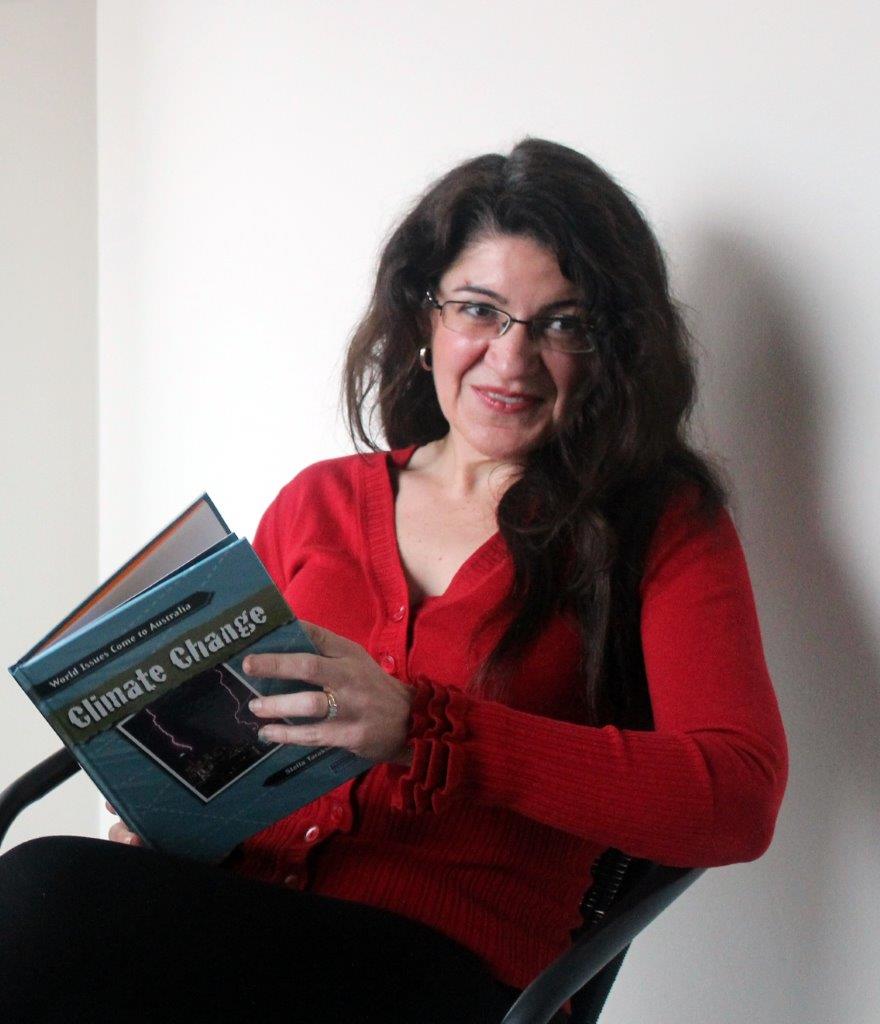
A Talk with Australian Author Stella Tarakson

In Paris, where I lived before I moved to the United States, several cafés are famous for the renowned writers who spent hours there writing but also exchanging ideas with other writers and artists. This one for example.

cafedeflore#2


Our blogs have in a way become the new cafés where we meet, comment, and also support each other along our artistic and creative journeys.

Today in my small café, I am very happy to welcome and introduce you to Stella Tarakson who lives and writes in Sydney, Australia.

Hi, Stella, and thank you for sharing a little bit of you and your writing journey through the following questions.

Stella

Your junior fiction book Mike the Spike has just been released. But if it is your first fiction book for children it is not your first book at all. Can you tell us about your early writing days?

My first books were law-for-the-layperson type books. I’ve got a law degree and that was a natural first step! I then started writing books for the educational market on all sorts of topics. Obesity, terrorism, euthanasia. All challenging to research and write, but highly rewarding. I’ve had 35 non-fiction books published, but when it comes to fiction I’m still a beginner.

What triggered your desire to write fiction?

I guess it’s the usual reason. I’m fulfilling a childhood dream! Like most writers, I’ve always loved reading. I was a complete bookworm when I was a child (I still am) and this is my chance to give something back.

Now who is this Mike the Spike?

He’s a cool little boy who is very vain about his hair. To his horror, he discovers he has head lice. He can’t bear the thought of anyone finding out, and tries to get rid of them himself. His attempts are imaginative, to say the least!

What about the title? Did you find it as soon as you got the idea of the story? Or did you have the idea of the character before the idea of the plot?

The title came last, after I’d written the whole story. I chose it to be in keeping with the other books in the ‘Little Rockets’ series. The idea for the story came first, then I needed a character to carry the story. I needed someone who’d be utterly horrified and embarrassed by the discovery of a louse. Not a girl – they’re too used to it!

Some writers stick to an outline while others write by the seat of their pants. What kind of writer are you?

Gosh, definitely an outliner! I find the idea of being a ‘seatser’ quite frightening. I’m sure I’d waste lots of time if I didn’t know where I was going. I create an outline first, but it does tend to change once I start writing.

Do you think that being already published was an asset when you sought publication for Mike the Spike?

It didn’t help me get a fiction publisher; the markets are quite separate. I’d tried several times before and it hadn’t helped at all! Once I sent a story to a publisher who ignored it entirely and asked me to write some business case studies! Still, I enjoyed the work and went on to write several. Being already published helped in other ways, though. I understood the publishing process and felt confident negotiating the contract.

With so many books published do you have an agent?

No, but I’d love one! We have very few agents in Australia – about a dozen. Of those, many have reached capacity and aren’t taking new authors. Of those that are, most don’t take kids’ writers. On the plus side, we still have several publishers who are willing to take unsolicited manuscripts. Mike the Spike was picked up off the slush pile. I think, though, if I’m going to continue with fiction, I’m really going to need an agent.

A traditional publishing house is publishing Mike the Spike. What part of marketing and promotion is left to you?

Quite a lot of it! Publishers – especially small ones like mine – expect authors to be very active in promoting their work. So thank you for helping!

You are regularly welcoming a mix of traditionally and independently published authors on your blog. Here, in the USA, the stigma that was once attached to the self-published writer is fading, mostly due to the better quality of tools that writers can use to publish their own work but also to a few exceptional success stories. How is it in Australia?

I think the issue here isn’t so much about stigma – but about whether it’s financially worthwhile. Self-publishing seems to be far more expensive here and we’ve got a tiny market. Many people who self-publish spend thousands of dollars and only make a fraction back. The situation is better with e-books, but it’s hard to make much money – if any – by self-publishing hard copy, especially fiction.

Now that Mike the Spike is in the hands of young readers, what are your next writing projects?

I’ve written another junior fiction novel that will hopefully become the springboard for a series. It deals with Greek mythology – and rightly so, as I’m Greek! Well … Greek-Australian. That’s still under consideration. In the meantime, I’ve been commissioned to write a non-fiction series about dangerous Aussie animals. No shortage of material there!

Evelyne, I’d like to thank you for having me on your blog. It’s writers like you that make the blogsphere such a warm and welcoming place!


The pleasure is all mine, Stella.

I encourage any writer and reader to visit Stella’s website: a mine of concrete information for writers and readers alike.

Of course, I also encourage you to get a copy of Mike the Spike available through the publisher and various online stores.

mike the spike

Now I only wish I could offer everyone a cup of coffee or tea so we can keep talking about writing and maybe even reading Mike the Spike together.


People Behind the Story of a Book

Still in Maine.

photo-290

Still canoeing.

photo-292

Still reading and writing.

image(7)


A few years ago I entered one of my manuscripts in the annual Amazon Breakthrough Novel Award – ABNA for short.

I figured that it would be a good way to get a reality check. Even brutal, the competition would position my work in comparison to other manuscripts.

Initially I had written the story for middle graders, but ABNA doesn’t have a children’s fiction category.

No problem, I thought, I will boost my characters’ age to fit the YA fiction category.

I didn’t win the jackpot but made it far enough through the competition to receive valuable feedback from the team of reviewers.

Not surprisingly the recurrent negative comment was related to the age of my characters.


Advice #1

Never, ever, think that writing fifteen instead of twelve will instantly morph your pre teens into teens.


Advice #2

They say to never take it personally but everything is personal, isn’t it?

So when I read this: “I wish you well and hope to complete this by buying this novel one day,” I thought that: One day I should give this story another chance.

Don’t turn a completed manuscript into an eternal Sleeping Beauty.


Over the last year, among other projects, I revised and edited this manuscript. For various reasons, I also changed the title and the name of my female protagonist (Sylvie instead of Françoise).

Today, I’m happy to give you a snippet of Chronicles From Château Moines, my novel for middle graders.

When the mother of twelve-year-old Scott dies, his father gets the crazy idea to move his family from California to Normandy. Now Scott must come to terms with his mother’s recent death while adjusting to life in France. He has no clue that his arrival is also a challenge to the locals, particularly to Sylvie. She doesn’t like this boy who turns her life upside down and threatens peace at school and through small town Château Moines.

Yet Scott’s intriguing and cute, and when the two of them share their love for music they slowly become friends. Their paths ultimately merge when Sylvie’s sister Elle momentarily disappears at the peace walk that Sylvie and Scott organize to protest the Vietnam War.

Set in 1970 and told from the perspectives of Scott and Sylvie, Chronicles From Château Moines is a middle-grade story about loss and friendship, about music and peace, and also about parents’ secrets.


I don’t want to brag, but in case you decide to read my book or suggest it to a child when it’s out,  here are some additional comments I received from ABNA Reviewers:

“I really enjoyed the relationships between Scott and his sister and Françoise and her sister. Most siblings don’t seem to have much of a role in books so I was glad to see some nice close families here.  
I was also anticipating what was to come with Scott and Françoise or Scott and Annie.”

“I really enjoyed what I read. I couldn’t wait to see what relationships were going to transpire. There were some really nice family relationships here as well. I would really enjoy reading the rest of this book. It seemed very well written.”

“This entry has some lovely prose that divides into two languages. I found this entertaining as I was learning French slowly while enjoying a tale. 
I believed the relationship between siblings as well the parental/child connection rang true. It seems the loss of a parent is germane to children’s writing; I am sure it sets the emotional tone for the story.
Good sentence structure. Dialogue was flowing, not stilted. 
The plot is charming and piques interest. I’d like to see what happens with both families.”
“This is a gentle story of culture shock, coming to terms with loss, and feeling the outcast. Françoise feels it as acutely as Scott though she has lived in France all her life. There are many forms of alienation in a teenager’s life and that is studied here. 
Warm story, worth reading.” 

photo-245

Words of encouragement, like the gentle nudge of a friend on a steep hiking trail, go a long way. Thanks to the reviewer who wrote that he hoped to buy my book one day, I was able to give my story a second chance.

The copy-editor I hired provided much more than line editing. Isabel Stein was my partner for my first novel Trapped in Paris. She has worked for many years with renowned publishers; she knows what she’s doing.

Writers who share their publishing adventure through their successes and challenges, and share their referrals are generous. Katie Cross not only published the excellent Miss Mabel’s School For Girls, the first book in the Network Series, she also created a special tab on her blog, just in case people like me searched for editors, copy editors, book designers, cover book designers, etc.  Thanks to Katie, I selected Jennifer to design the book cover of Chronicles From Château Moines. I cannot wait to see what she comes up with!

Anyone who believes in your writing deserves special recognition.

My husband was at the front line and backstage for Trapped in Paris. He did it again for my new book. It’s great that he favors technology to fiction writing. We don’t fight about who is more creative or less technical. I owe my husband countless hours of work and a few occasional funny French bad words that I had forgotten. Formatting a manuscript for a printed version and an e-version can be a real pain. I want to add that Chronicles From Château Moines and Trapped in Paris are printed by Createspace but not designed by the company. The choice of font and paper as well as the interior design are solely my husband’s work. I am really happy to share the life of a French man turned into an American entrepreneur. A keeper, I’m telling you.

Of course, you are also crucial to my writing journey. When you read one of my posts, either in French or in English (some brave ones do both!), when you like one of my posts, when you comment on one of my posts, you push me to write yet another post and moreover to improve my writing skills.

Thank you for being part of my journey.

IMG_0094

I will share more of my book as the launching date approaches, so stayed tuned and bear with me.

Meanwhile, here is the song that plays when Scott and Sylvie dance together for the first time.


Meet My Character Blog Tour


L1010996

Last week, a fellow blogger invited me to be part of Meet My Character Blog Tour.

Sherri blogs and writes from England, her native land, after many years spent in California. Although she didn’t have to learn a new language, she had to adjust to a new lifestyle as she raised her children in the Golden State.

I also live in California, away from my native France. This common characteristic established a natural bond between Sherri and me. Although we’ve never met and communicate only through our blogs, I’ve learned a lot about Sherri and the challenges of her life, thanks to her regular posts and gorgeous photos. She is now at work on a memoir.

Thank you, Sherri, for thinking of me for this event.

It’s now my turn to tell you about Cameron, the main character of my novel Trapped in Paris (for readers 12 and up).

1. What is the name of your character? Is he/she fictional or a historic person?

Cameron is the main character in my novel. He’s sixteen, American, and the product of my imagination.

2. When and where is the story set?

The story is set in Paris and the Parisian suburbs in April 2010 when a volcano erupted in Iceland, disturbing air transportation through most of the world for days and even weeks.

3. What should we know about him/her?

Cameron lives in Portland, Maine. His father owns a small float of fishing boats and expects Cameron to work with him someday.

Cameron is the middle child of five and also the only boy, which gives him a good understanding of girls and a natural respect for them.

Cameron is close to his mother, a third-grade teacher, and to his fifteen-year-old sister Maddie.  He also adores his eight-year-old sister Rose.

4. What is the main conflict? What messes up his/her life?

Cameron’s girlfriend Lilley has dumped him brutally for another boy. This recent broke-up episode adds to Cameron’s natural prudence.

He has never told his father that he’s scared of the ocean and that he doesn’t want to be a fisherman. Although he has never traveled away from his native state, Cameron’s curious about the world. So when his High School’s French Club plans a trip to Paris over spring break, he wants to go. Still heartbroken, he doesn’t want to fall in love ever again.

So when he’s stuck at the Paris airport when the volcano erupts, he wants to stay away from Framboise, a girl he meets there. Yet this girl’s different from his former girlfriend,  intriguing and convincing, and when she suggests to leave the airport for Paris, Cameron gives in.

When he and Framboise witness a crime on the River Seine, they are kidnapped by a dangerous man and kept in an empty flat. From that moment, the two of them will become unlikely partners in a fast, action-packed four-day adventure through the Parisian suburbs.

5. What is the personal goal of the character?

For the first time, Cameron is confronted to several new, important experiences.

He fell in love and a girl broke his heart.

He’s miles away from home.

He’s stuck in a foreign airport.

He meets Framboise, a girl who speaks three languages, has traveled the world, and is adventurous.

He will have to rely on Framboise while he wants to stay away from girls.

He will also have to trust his survival instinct, brave danger, and act with courage to help Framboise when the two of them get separated.

Ultimately Cameron will learn to believe in himself.

6. Is there a working title for this novel, and can we read more about it?

When I started this story, a title jumped to my mind: Ash Cloud.

I thought it would be the final title until a writing friend told me that Ash Cloud was misleading. My husband shared the same opinion, so I reconsidered. Changing the working title wasn’t easy, but ultimately I agreed that the volcano eruption triggers the story but isn’t the main topic.

The final title Trapped in Paris is the product of a brainstorming session between my husband and me.

7. When can we expect the book to be published?

I published the novel in the fall 2012. It’s available through Amazon and can be ordered in any bookstore.

Last fall, I teamed up with the same editor for a new novel that will hopefully be available before the end of 2014. In addition, I have two other completed manuscripts that I intend to publish as well. I have also recently submitted a short story to a French publishing company for an anthology.

A Petunia's Place, samedi 26 novembre 2012

At Petunia’s Place, November 26, 2012


I’m happy to return Sherri’s invitation and invite other writers on Meet My Character Blog Tour.

You’ll notice that the five of them are women. Nothing against men! Several men are among my favorite writers. And I also know terrific bloggers who are men.

I selected women to support the #ReadWomen2014 twitter initiative.

I owe the idea to Kimberly who wrote about it earlier this year.

The writers below are women I respect and admire.  Their writing and blogs inspire me. They make me feel good about being a woman and hopeful for a kinder world in which art would play a more active role.

L1010998

Listed in alphabetical order and not in order of preference, using the blogs’ names:


Alvarado Frazier

Life Between the Sheets (of paper): Story, Art, and Poetry

Mona writes posts infused with poetry. In addition to her poems, Mona has completed a YA novel, now a quarter finalist in the Amazon Breakthrough novel. Cheers to her success!

I was drawn to Mona’s blog because of her American-Mexican heritage, and the fact that she’s using challenges and work experiences as powerful ingredients in her writing.

Harvesting Hecate

Thoughts on life, writing, creativity and magic

Andrea runs a high quality blog where I always read beautifully crafted posts and also find inspiration to fuel my own writing. Her posts about creativity are among my favorites.

Andrea’s writing has been noticed and recognized. Her list of awards and prizes is too long to list here.

Kimberly Sullivan

Thoughts on reading, writing, travels, and all things Italian

I could only be attracted to Kimberly’s blog. Kimberly was born in the US and lives now in Italy with her family. Besides her regular blog posts, Kimberly writes fiction. Many of her short stories have been published. I read Amica del cuore in the anthology Foreign and Far Away and liked it very much. Kimberly has completed two fiction novels.

Stella Tarakson

Author – children and young adults

I like Australian writers – Markus Zusak is my favorite – so when I met Stella who writes from Australia, I knew I would feel at home.

Through her extensive teaching and writing experience Stella provides concrete advice to recent and more seasoned writers. Some tips apply more specifically to Australian writers, but inspiration and support are international. Stella has already published many books. Some of them have received awards. Her latest book will be in print this year.

Teagan’s Books

Teagan Ríordáin Geneviene is one of the most unique and creative writers I’ve met online.

She writes fantasy fiction and started blogging when she embarked the indie boat to publish her novel Atonement, Tennessee.

As a personal practice exercise Teagan started a project called Three Ingredients. Using three cooking or baking ingredients, she concocts the most original posts, blending plot, characterization, and setting with the expertise of a chef. Et voilà! Due to her readers’ enthusiastic response, she’s at work on Cookbook 2.

L1010921

I hope you will take the time to visit these women writers to read more about their work, either published or in progress.


Still Writing…

L1010683


When AP testing will be done, finals over, high school graduation a memory, and summer vacation almost there, I will be visiting a local high school.

It will be so close to the end of the school year that I wished I could simply sit down with the kids, listen to their summer plans, ask them about the books they like, and the stories they would like to read.

In my perfect plot I would be a host.

But the school counselor and the AP English teacher have invited me to talk about writing.

It is not the first time I visit a school, a library, or a bookshop.

But in the past, my visit was linked to the recent publication of my novel, to a specific event, or in collaboration with other writers.

When I’ll go to that school I’ll be alone, and although I can bring copies of my book, the main purpose of my visit is to talk about the process of writing.

When you spend huge amounts of your time making up people, crafting twists and turns and ups and downs to create suspense, pondering one work over an other, don’t you think it’s a little weird to be invited to talk about this process?

Should I talk of the time I spent yesterday over chapter 21 of my new novel? Of the hard time I had to hush the racket playing in my head, so I could re-enter the world of my people? Of the fluttering inside me when I found my pace and ran to meet my main character’s expectations? Or of my disappointment when I had to click on Save because I had to pick up my son at school, while I would have loved to stay?

Who could be interested to know that?

Seriously, in a world that gives more importance to material possession than art, more power to the product than the journey to build it, more visibility to quick success than behind the scene labor, is it important to talk about writing?

But I’m invited and feel a greater responsibility than when I ask to come over.

In the same way considerate guests arrive with a bouquet of flowers or a bottle of wine when invited for dinner, I want to bring something special with me.

As I searched through my files and power presentations, I find that too much is about me, about my personal journey, and my work.

SAM_1422

I would like for the students to value words as exquisite and powerful artistic tools.

Words are what notes and instruments are to musicians, watercolors, oil, and brushes to visual artists, stone, glass, wood, and carving utensils to sculptors.

Our palette isn’t limitless but our possibilities infinite.

Like most writers did when they were teenagers, high school kids write to make sense of the complexity of their feelings and emotions, of their wounds and their moments of happiness, and also just for the fun of telling a story.


I would also like to be honest.

Writing, unlike some other jobs, is never perfect. This imperfection triggers moments of doubt. Is it worth of my time to sit for hours and write?

On the other hand, although most people but artists will find this strange, the richest aspect of writing, in my opinion, resides in its imperfection. I find the search for higher quality very rewarding.

When people find out that I write, some of them believe that writers are rich. I assume financially rich.

Some are such great and prolific writers that they sell lots of books and make money.

Many of us, however, will spend our lifetime without knowing this form of success.

Does it mean that we should stop writing?

Most writers have a day job and still write.

Not when we find the time to write but in the window of time that we’ve purposely designed for our writing.


I would also like more questions than answers.

SAM_0265

And I would really like to take a few people with me.


KCross for her upbeat attitude and marketing skills.

The Eye Dancers for his unique way to tie his writing to other forms of art.

Stella for her extensive writing and teaching expertise.

Mona for her work infused with poesy.


That would be a killer team.

In some ways, they will be there.

We write inspired by the authors who left their mark when we were young, and others when we became more sophisticated readers.

And we share our passion for words and stories, nourished by the passion of other writers.

photo(5)

What or who do you bring with you when you visit children or teens and are asked to talk about writing?

Junie B. Jones Is Still Alive

I never check my phone at 6 a.m., but a text from my daughter caught my eye.

“Barbara Park died.”

A little girl, cuddled on a sofa, deaf to her siblings playing nearby and to her mother’s call for dinner, because of a fictional character, is the best compliment for a writer.

Few adults are able to put themselves in the shoes of their six-year-old self.

Even less can write about what being six means.

Barbara Park did remember being six. She even said that she was six.

Junie B. Jones, the loud-mouthed first grader, wasn’t exactly a role model, and I met some teachers who didn’t like her that much. They found her challenging, I bet.

But to the kids she was a real kid. And they loved her.

When I cleaned my family library this winter, I kept many books from the time my children were very young. I couldn’t find the Junie B. Jones books.

Barbara Park kept Junie B. in first grade for years, before she moved her up a grade.

I wonder if she hasn’t gone to college.

My Sister and The Famous Five

I was told that I learned how to read watching my father turn the pages of L’Orne Combattante, one of the local newspapers published in my native Normandy.

I remember of the rough texture of his workpants against my small fingers when I gripped his leg to sit on his lap.

“Papa, what does it say? Tell me the story. Please, what is it?”

I remember that my father smelled of Gauloises cigarettes, masculine sweat, and cologne, while my mother smelled of coffee, French chalk, and eau de toilette.

My father drove trucks from Normandy to Paris every single day.

My mother was a seamstress working from home.

When my mother sewed, she listened to the radio.

When my father wasn’t driving, he read.

So it is possibly true that I learned how to read with my father.

I was also told that my paternal grandfather, blind by the time I was five, had been an avid reader. It is also possibly true since he encouraged my hunger for stories.

“Buy a book,” he would say, slipping crisp French bills or shiny coins in my hand for my birthday and Christmas.

I was six when I bought my first Club des Cinq books. I had no idea that The Famous Five series had been first written in English.

My favorite character was Claude; George in the original version. It was no coincidence that this girl had a unisex name.

In a world dominated by men, where girls who loved to climb trees and ride their bikes recklessly were called tomboys, Enid Blyton had created a girl who broke barriers and killed clichés. Claude/George was capable, smart, and witty: she was my dream friend and role model.

I grew up years away from Katniss and Tris, the strong female characters that inhabit contemporary YA literature. However, for the kid I was, The Famous Five, among other similar series, responded to the same urge for freedom and independence that I craved.

I remember stormy Thursday afternoons when there was no school. Wind slapped the shutters against the windows and rain pelted the roof while I read, my back propped against pillows, with the radio playing French and British songs and the humming of my mother’s sewing machine for background.

The occasional “Zut” that my mother uttered when she pricked her finger with a needle reached me through some kind of dreamy fog. Entangled in the story, she had to pull me away from “this darned book” while my sister focused her attention on strips of fabric that my mother didn’t use.

While she created clothes for her dolls and mini curtains for their houses made out of shoe boxes, my mind was in another world, caught up in solving a mystery that involved good and bad guys.

My sister didn’t like the fact that I refused to play with her when I was in the middle of a book. When I agreed, I invented games, which almost always involved two girls alone in the wilderness. We had to fight for food, for a roof, for protection. We had to fend for ourselves, away from the safety of the guest bedroom where our mother sewed. We were free from the rules of the adult world.

My sister didn’t like these game scenarios very much. Moreover she resented the time I spent with my books because she didn’t like to read.

And this is how I became a writer.

For the avid reader I was, my sister’s indifference toward stories and books was a mystery that I had to tackle.

When we are children we are afraid of the dark, of the school bully, of the creepy neighbor, and of being the only one who thinks crazy thoughts, but we are also fearless in the sense that failure hasn’t become yet a wounding word.

I figured that if my sister didn’t like to read she hadn’t found the right story. In my nine-year-old mind it was as simple as that.

This is how I wrote my first story.

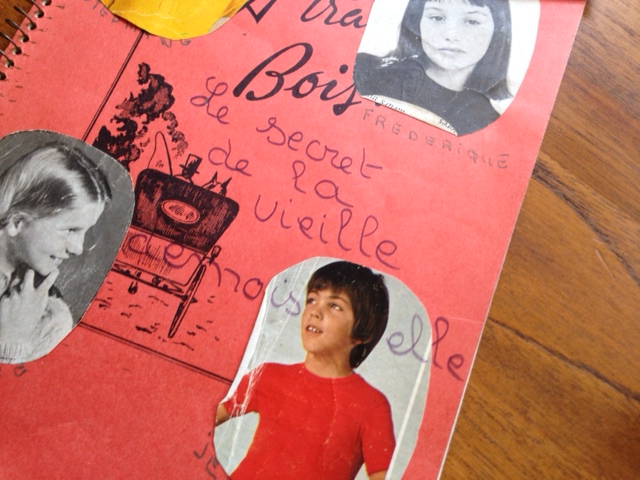
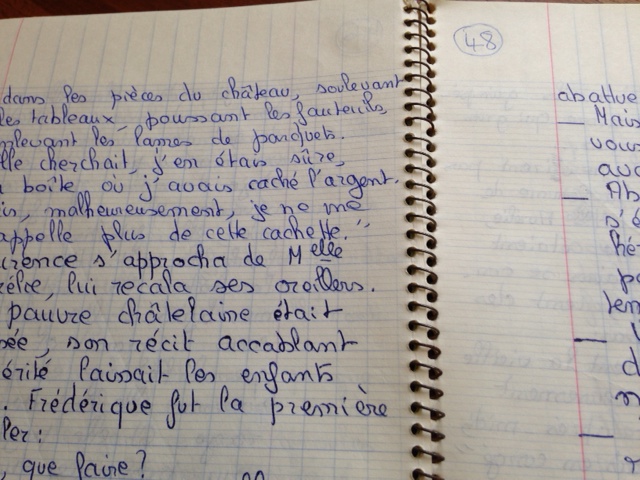
I wrote in two thin spiraled notebooks because I loved series. My sister had to get a book with two volumes.

I cut out pictures from La Redoute and Les 3 Suisses – the French versions of the JC Penney catalogue and glued them on the cover. My sister had to get illustrated books.

photo-135

I mimicked the design of my beloved Enid Blyton’s books, including the ISBN and the readers’ age. My sister had to get legit books.

photo-133

My protagonists were two girls and two boys. The savviest was Frédérique, which is the female version of Frédéric; close enough to a unisex first name.

The plot was simple. A former rich old lady can’t remember where she hid her money in her dilapidated castle. Thanks to four smart kids the treasure is recovered after days of adventures.

Yes, the ingredients of my first story were similar to the ones Enid Blyton used for her successful plot recipe. The title mimicked hers too.

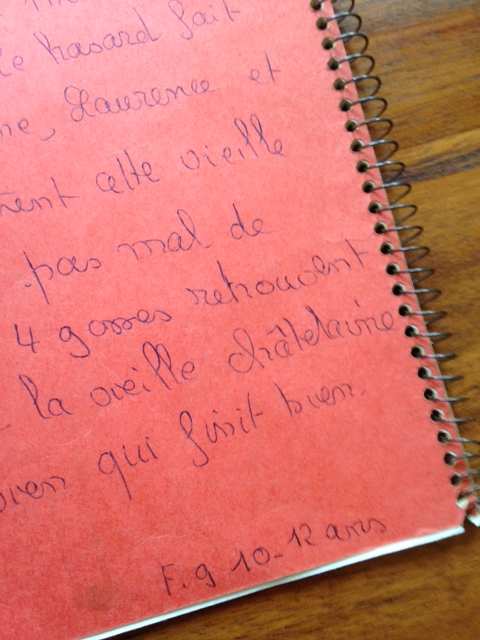
Le Secret de la Vieille Demoiselle (The Old Lady’s Secret), my first story, was followed by many more and also by poems as my discovery of writers and exploration of literary genres grew.

I was ravenous and never satiated, so like many people who love books I entered the publishing industry.

This is where I learned how books were made for real. This is also where I quit writing.

At least until I left Paris for California where, submersed by so many intense new experiences, I had no choice but write again.

In French first.

Then, years later, in English.


Over one recent summer, my sister and I got to spend more time together than we had for years. Our days in the company of each other in our parents’ home triggered long conversations punctuated by comfortable pauses that a common childhood allows.

Over countless espressos and late evening talks we shared lots of stories. Exactly twelve months separate my sister and me. Nothing now that we are adults. A whole world when we were children. Over these short but charged summer weeks, we were once more our parents’ children. And I was again the eldest.

This is why my sister was the one who spoke of the books I had written for her when she was eight.

“I still have them,” she said.

The following day she handed me Volume II.  “I’d like you to have it,” she said.

As a kid my sister had preferred Volume I. She had given a valuable lesson to her apprentice writer sister: the first chapter and even first lines of a story are very important if a writer wants to capture the limited attention of a reader.

“It could be fun for you to read your first French story,” my sister went on.


I had never re-read Le Secret de la Vieille Demoiselle.

When I flipped open the first page, my fingers cramped.

I wrote this story by hand, and in a Proust moment, this notebook triggered a rush of sensory and emotional memories.

photo-134

I remembered of tiredness when my hand clasped around my pen, of challenge, too, when I struggled with the plot. I was nine years old after all.

But the moments of pure joy when I found a word I liked, an idea to build more conflict, or simply when I forgot that I was a little girl and was instead a writer, were as vibrant as they were back then.

I read the story with affection and respect for the girl I was once. My childish words carried ideas, emotions, and tastes that are still mine.

When I closed the notebook, I remembered with equal affection of The Famous Five.

The first books that triggered my desire to write my first story were originally written in English, foreshadowing my future life in a country where I would someday learn how to write in English.