To Save for the Rainy Days or a Month of French Idioms From A to Z

By now you may have noticed that food is part of many popular French expressions. No doubt that food and perhaps more importantly the rituals around food matter in France. Today in the series of French Idioms from A to Z, a very common expression that I heard a lot, growing up in a French middle class family where nothing was wasted, even less food, and where saving was my parents’ way of life.


GARDER UNE POIRE POUR LA SOIF 

TO KEEP A PEAR FOR THE THIRST

TO KEEP OR TO SAVE FOR THE RAINY DAYS


Embed from Getty Images


This expression would go back to the 16th century, using the juicy pear, a fruit able to quench the thirst, as a metaphor for the necessity to save for the unpredictable moments in life.

If you just started to read this series, I have to tell you that in my early days in the USA I always thought in French before speaking in English. Literal translation, I found out, rarely works.

So yes, I’ve said once to someone that it was a good idea to keep a pear for the thirst in the same way I told another that I had a cat in my throat (a frog restrospectively would have made more sense for the French!) and that I liked men in smokings (tuxedos).


See you tomorrow!


A to Z Challenge

To Make a Whole Cheese or a Month of French Idioms From A to Z

One said that French President Charles de Gaulle once proclaimed that France was a difficult country to govern and that it was in fact not surprising coming from a place that had more cheese than days in a year. So this is also not surprising that there is a French expression based on the French cheese reputation.

Oh and French people say Cheese when they snap a photo.


(EN) FAIRE TOUT UN FROMAGE

TO MAKE A WHOLE CHEESE

TO MAKE A STORM IN A TEACUP


Embed from Getty Images


My research about the origins of this typical French expression led me to too many possible options, none based on reliable sources. So I prefer not adding to the confusion.

Another popular French expression with the exact same meaning is: En Faire Tout Un Plat, which literally means To make a whole dish.

Despite making my mouth water at the thought of cheese, I tend to find the English expression more visual and better suited to the meaning than the French one.

What do you say?

See you tomorrow.


A to Z Challenge

To Send to Pasture or a Month of French Idioms From A to Z

Hope you all spent a great weekend and are ready for a long week of French idioms. From Monday to Saturday, I will provide an expression, covering the alphabet from E to J. As always, thank you for your comments and for adding your own idioms to mine. I’m glad if you learn something you didn’t know, but I’m as glad to learn from you, too.


ENVOYER PAîTRE

TO SEND TO PASTURE, TO GRAZE

TO SEND SOMEONE PACKING AND ALSO THE INFAMOUS GO TO HELL

Go to Hell remains somehow controversial in the USA and yet widely used, especially in the movie industry.


Embed from Getty Images


Envoyer paître is a French expression from the middle of the 15th century, when the verb paître had a religious connotation. People’s salvation was associated with God’s pastures where the soul was fed.

In later years, the expression evolved, based on the tradition to send cows to graze in far away pastures, and took then a negative meaning.

Envoyer paître simply means to get rid of someone in a sudden way.

There are, as often in the French language, some variants to the expression.

For the French here or anyone who speaks some French: envoyer aux pelotes, envoyer ballader, envoyer bouler. Vous en connaissez d’autres?


A to Z Challenge

See you tomorrow!


To Give One’s Tongue to the Cat or a Month of French Idioms from A to Z

In the series A Month of French Idioms From A to Z, here is letter D!

DONNER SA LANGUE AU CHAT

GIVE ONE’S TONGUE TO THE CAT

TO GIVE UP


Embed from Getty Images


This is a French expression from the 19th century, which supposedly comes from an older one. Originally one gave the tongue to the dog and not to the cat, based on the common custom to give leftover food and the less tasty morsels to the family dog.

Why did it switch from the dog to the cat?

In France (and many other countries) the cat was seen as an animal able to keep secrets, which could by extension keep the tongue given to him.

On the other hand, to give your tongue to the cat symbolizes failure. If you give your tongue to the cat you give the animal a lot of power, increasing the notion that the cat has more knowledge and wisdom than you.

I won’t contradict this: I love cats and find them very wise.

This French expression is used commonly when people can’t find the solution to a guessing game and also to a complex problem.

As a kid I often gave my tongue to the cat when playing math games with friends!


See you on Monday with letter E.

Meanwhile if you celebrate Easter, enjoy this special day. In France the bells coming all the way from Roma bring chocolate eggs and other goodies to the French children. Ici aux USA c’est un lapin qui remplit les enfants de joie le matin de Pâques.


To Switch Dairy Shop or a Month of French Idioms From A to Z

France is well-known for its cheese and dairy products. It is not surprising that there is a French expression using the national bounty.


Embed from Getty Images


CHANGER DE CRÉMERIE

TO SWITCH DAIRY SHOP

TO TAKE ONE’S BUSINESS ELSEWHERE


The crémerie in late 19th century France was an unpretentious neighborhood restaurant where simple food was served with coffee.

One said that late customers, asked to leave at closing time, would protest saying they would go to another crémerie.

Since late 20th century this French expression is used in a commercial context. Unhappy customers take their business elsewhere.

A crémerie is not longer a small restaurant in contemporary France but the shop where dairy products (we’ve got a ton in France!) are sold.


A to Z Challenge

P.S. As always if you know a similar expression either in French or American English, go ahead! I am very fond of idioms as they say so much about a culture and its people.

To Have an Artichoke’s Heart or a Month of French Idioms From A to Z


As announced last week, from April 1st to April 30th and following the alphabetical order, I will post every day but Sundays a French idiomatic expression, its literal English translation, and its proper equivalent or meaning in American English. I’ve had my share of embarrassing (and funny) moments, due to my non-native English status. You’ll see why such moments can happen!

Many bloggers participate to the A to Z challenge with their own themes. If you are one of them and chose to write around language, foreign language, and culture, I’d love to see what you are up to and I hope you’ll stop by to check my posts as well.


STARTING WITH THE LETTER A:


Embed from Getty Images


AVOIR UN COEUR D’ARTICHAUT

TO HAVE AN ARTICHOKE’S HEART

TO FALL IN LOVE EASILY


As always I love to read your comments. In English, en français, or anything in between.

I Have the Hen’s Bumps or a Month of French Idioms From A to Z

photo-99

I love to read and listen to people even more than I like to write.

Sentences stop me in my tracks when they flow, roll and dance in my head.

Metaphors and similes take my breath away when they perfectly echo feelings and emotions.

And I’m a sucker for popular idiomatic expressions, so distinct from one culture to another.

When I moved from France to the USA, I knew enough English grammar and some vocabulary to get by, but I was far from being fluent.

Everyone was so patient when I tried to understand and be understood.

Some people complimented me on my English. No kidding.

And often I made many smile when I translated word for word the French idioms that I tried to apply to the conversation.

My first one: I announced to my daughter’s preschool teacher that I had the hen’s bumps because it was cold that day.

“And I have the goosebumps,” she said with a smile.

So, in memory of my early challenging (and often funny) moments in the States, I will post every day for the whole month of April a French idiom from A to Z, first with its literal translation and then its correct American equivalent.

My hope is to make you smile and maybe to teach you a little bit of French too.

Of course, as always, I’d love for you, Americans and French, to comment with your favorite idioms during the month of April.


French Memories


A Galette des Rois and a Kings’ Cake

Traditionally a religious celebration commemorating the visit of the Three Wise Men to baby Jesus, Epiphany Day is thoroughly enjoyed in France beyond the official January 6th and beyond religious meaning, too.
All over the country, bakeries sell the galette des rois (Kings’ Cake) in different versions depending on the French regions.
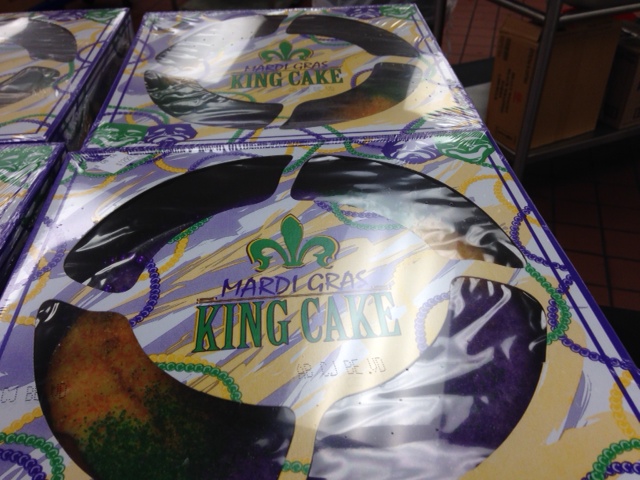
Americans are more familiar with another Kings’ Cake, a Louisiana specialty.

photo-123

Unlike the French who celebrate the end of the Christmas season with the Epiphany, the people of Louisiana celebrate the beginning of Lent with the famous New Orleans Carnival mid February. Mardi Gras or Fat Tuesday is celebrated the day before Ash Wednesday, the first day of Lent. During the Carnival, thousands of locals and out of state visitors savor the Kings’ Cake.

The galette des rois I know best, however, is made of puff pastry filled with almond paste.

photo-358
Despite the diversity of the cakes, the tradition of hiding a small plastic or porcelain trinket inside the dough is the same. In France, family and friends gather pour tirer les rois or to draw the kings.

Traditionally the youngest person in the room hides under the table and decides who gets which slice of the cake. Then whoever finds the trinket is crowned king or queen and can pick his queen or her king. The following year this is the turn of the king or queen to host the party.
In the old days a dry bean or fève in French was hidden inside the cake. One said that cheap people swallowed the bean so they wouldn’t have to host the event the following year. And this is how tiny porcelain trinkets replaced the traditional beans. Who knowns? In any case, the trinket is still called fève.
When I was growing up, the fève had some kind of Christian connotation: a manger, a lamb, a star, a baby Jesus, an angel, or still a shepherd.
Nowadays the selection is more eclectic which explains why a museum in Blain, on the French Atlantic coast, and another one in Ronel, in the Midi- Pyrénées region, display them.

photo-98
I love anything with almonds and almond paste, so I like the galette des rois very much. Yet more than the cake, this tradition reminds me that the French love the association of traditions, food, family, and friends.
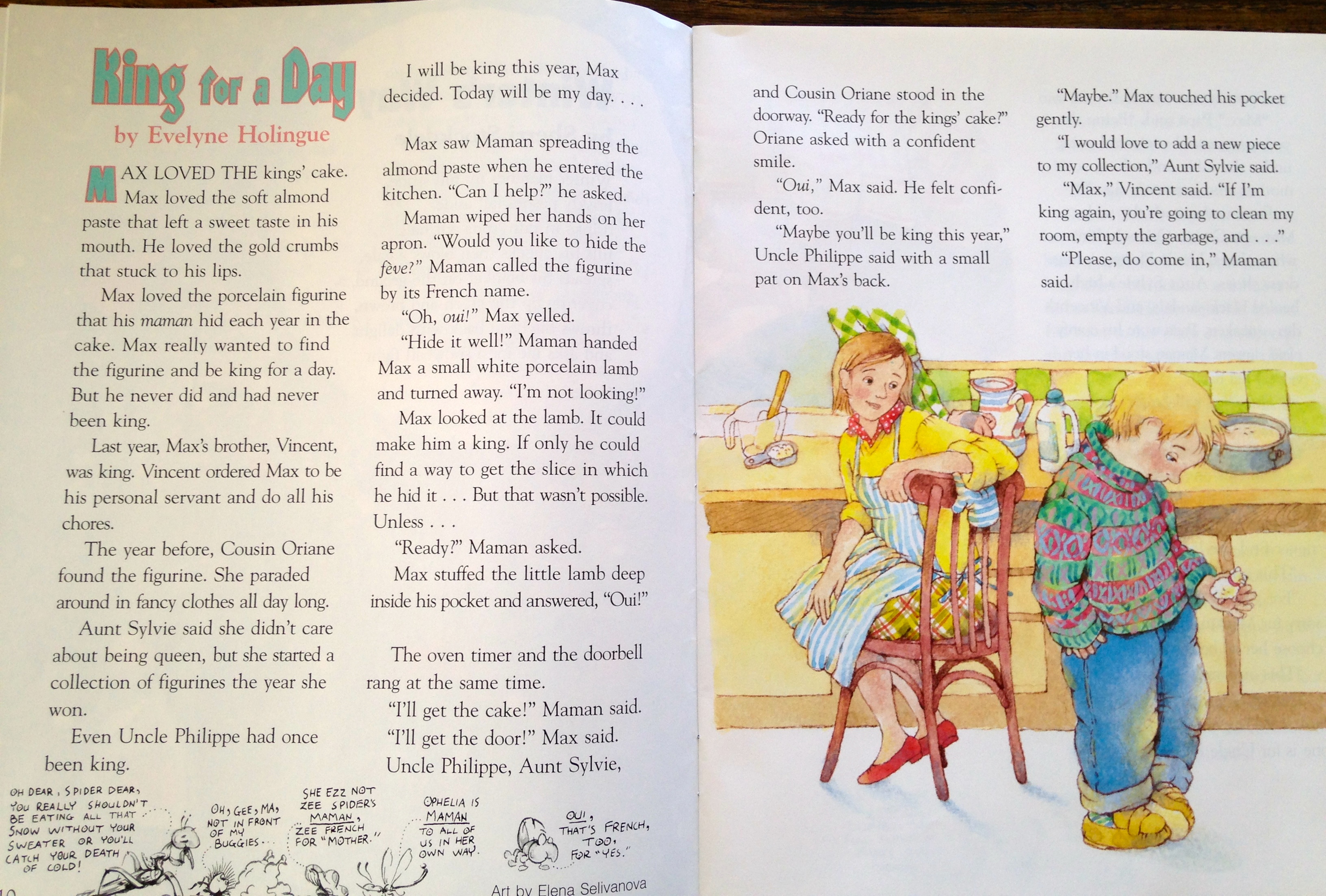
I also enjoy sharing the traditions of my native country. One of my very first children’s stories happened to be about the galette des rois. Like Max, the protagonist, I was tempted more than once to cheat and steal the fève to be queen for a day.

IMG_0473
Pelican Publishing Company, based in Louisiana, has published several children’s books around the Kings’ Cake and the New Orleans Carnival.
I like their most recent picture book (2008) Timothy Hubble and the King Cake Party written by Anita Prieto and illustrated by Virginia Howard.
Timothy has just moved to New Orleans and worries about this strange Kings’ cake “with a baby baked inside” that his new friend describes to him. Of course, things will turn around in a good way for him.
However, his initial reaction reminds me of the first time I introduced the French tradition to a California teacher.

This teacher taught at my oldest daughter’s preschool and she wanted her students to learn about their classmates’ cultural heritage. Parents were invited to share traditions from their native country. The teacher didn’t know about Epiphany Day, so she was happy for my participation. Until I told her that I would hide a small trinket inside the galette des rois.
“No, no, no”, she said. “You can’t do that. Imagine if one of the children swallowed this small thing.”
“Oh, it won’t happen,” I said. “I ate many Kings’ Cakes and I never saw anyone who swallowed it.”
“No,” she insisted. “Besides, some kids could be allergic to almonds. Can you bake another cake?”
I thought that the teacher overreacted. Yet I could only obey. So I came to school with a homemade pear cake. It had nothing to do with the galette des rois and no trinket was hidden inside, but we were safe. I explained the tradition to the children.
“Where is the small thing?” asked a little girl, digging with her plastic fork through her slice of cake.
Patiently the teacher explained that an object inside the cake would be too dangerous for children. The little girl nodded and asked if she could have more cake.
Years later I purchased my first store-bought galette des rois.
When I opened the box I saw a note taped inside the cover. A warning about the trinket/fève tucked inside the cake and the fact that it was baked with almonds was printed in bold. A description of the tradition followed in regular print.
I wasn’t surprised to find such a note and in retrospect agreed that the teacher had two valid points.
You see, after years in the States, what once shocked me has lost its strangeness.
Speaking of cake, can I ask you why the Americans say: “You can’t eat your cake and have it, too?”

photo-124

Because I think that I have in fact the best of both worlds.