Antidote to Doubt

I have been experiencing a long period of doubt since I started my new YA manuscript a year ago.

Early on, my critique group offered some valid plot-related tips, but they implied significant changes. Call it discouragement or fear of failure. The result was that I dreaded the perspective of revision and change.

What is the point? Is the story even interesting? Will readers like it?

I took a break and did my very best to forget about this specific manuscript. Oh I was still writing. In fact, I completed the editing and copy-editing of my middle grade novel that will be published later in the spring, I wrote many blog posts in French and English, and I even started another project.

Although I pretended to be done with my manuscript, I wasn’t tranquil. The story and the characters were on my mind, especially the protagonist – a high school senior.

He spoke out loud when I was driving. He visited me at the most unexpected moments, especially when I was quiet, cooking or folding laundry. I did my best to push him back when his presence started to feel more and more real. One night he showed up in my dream.

I knew he wouldn’t leave me in peace.

So yesterday I dug through my Documents and clicked Open.

Let me tell you that I was far more annoyed than excited.

The anticipation of work wasn’t pleasant at all. I knew I would have to go back to the very beginning. I have typed one hundred and thirty pages and just couldn’t delete entire chapters, so I copied/pasted what I wouldn’t need in a New Blank Document. You never know.

I hated every minute of it. The realization that a manuscript needs serious work isn’t enjoyable. But I stayed in my chair – it helped a little that I got a nice one for Christmas – and forced myself to read from the first page to the last.

When I was finished I had clarified two important points:

1-    This first part of the story is too long (I plan to divide my story in three parts)

2-    The characters deserve a chance to live

However, the task ahead of me still freaked me out and doubt was still bothering me. Same old questions.

What is the point? Is the story even interesting? Will readers like it?

I took a short break and checked my Inbox.

The title of Mona’s latest post caught my eye and made my heart beat faster:

Do You Believe in Yourself?

First a small smile grew inside me, and then renewed energy flowed through my entire body when I visited the website that Mona had linked to her post.

Yes, we are alone when we write.

Yes, we doubt of our voice or of our characters’ voice.

Yes, writing is difficult.

Yes, we have to do it ourselves.

When living these moments of doubt we need a little bit of help. And nothing can be better than:

1-    A positive blog post

2-    Writers’ hands to lead us along the creative path

3-    Messages of encouragement from writers who have been there.

What do you do when you are afraid, lonely and you doubt of your words? What is your andidote?

photo-105

Getting Your (and My) Ask Out There

One of Bob Baker’s articles posted on The Book Designer has recently caught my attention.

To Succeed as an Author, Get Your ASK out There!

Hum, hum, I thought.

Although all writers I know are people-persons, I don’t know many who are comfortable with pushing their book into the hands of potential readers and buyers.

On the other hand, most writers don’t have a problem talking about books they like and about writers who deserve to be read.

So I thought I would ask you to pay a visit to the following writers who in addition to their blogs have also published a book in the last twelve months.

The 228 Legacy

By Jennifer J. Chow

This book held the ingredients that instinctively draw me to a story: family saga told through three generation women, people torn between two languages and cultures, the first novel of a young writer. So it made sense for me to read it.

But I wasn’t expecting to learn about the history of Taiwan. We all belong to a place that shapes us. Jennifer has successfully linked a personal event to a page of Taiwan’s history. And added Jack, an interesting male character, to the classic trio of women.

You can read more about Jennifer and her writing on her blog.

Rise of the Writer: Writing and Marketing Like a Pro in the 21st Century

By Joe Warnimont

Writers of all genres will find helpful tips in this practical and honest book.

Practical because Joe provides clear and specific tips on how to write and market in the 21st century.

Honest because he doesn’t pretend that it is easy or will produce instant results.

Joe has managed to write a book for writers who aren’t high tech experts but are aware of the importance of social media and online presence. I wasn’t looking for writing help, but you will find helpful tips in this area as well, and also humorous nuggets on how to live a healthy writer’s lifestyle.

Written in an approachable voice that makes his blog enjoyable, Joe offers a little book that will give you big ideas on how to `rise as a writer.’

You can read more about Joe and his writing on his blog.

Love for Now

By Anthony Wilson

This very personal memoir offers a glimpse of a life transformed by cancer. The fear, the physical pain, the ups and downs, the support of friends and family, the clumsiness of acquaintances, the care provided by nurses and doctors: everything is documented as in a journal.

It could be too much, yet I found the memoir deeply positive. Friend’s visits, descriptions of the seasonal changes – yes, life goes on even when we are very ill – of food cravings – funny and touching at the same time – of poems and TV shows, which accompany Anthony as he goes through his treatment and his warm and realistic relationship with his wife and children – I have a weakness for the boy, the youngest – all touched me because it comes from the heart of someone who loves life.

Because Anthony is British, there is also a lot of humor – never hurts, especially in a book that tells of living with cancer. There are also beautiful sentences throughout the book. It is no surprise, though, as Anthony is also a poet.

This little book should be left in oncologists’ waiting rooms.

You can read more about Anthony and his writing on his blog.

Well, I thought when I was finished, I’m not so sure I‘ve followed Bob Baker’s advice.

But do I really have to ask people to check out my book?

Okay, I’ll do it.

You can read what other readers wrote about Trapped in Paris on Goodreads where you are welcome to add a review, too. If, like me, you are a late holiday shopper and still have a gift to make to a young teen in your life, a book is a great choice.

A printed and electronic version of my novel are available on Amazon, but your bookseller can order it through their distributor as well.

Phew, I really got my ASK out there.

photo-55

Between Promise and Anxiety

photo-36

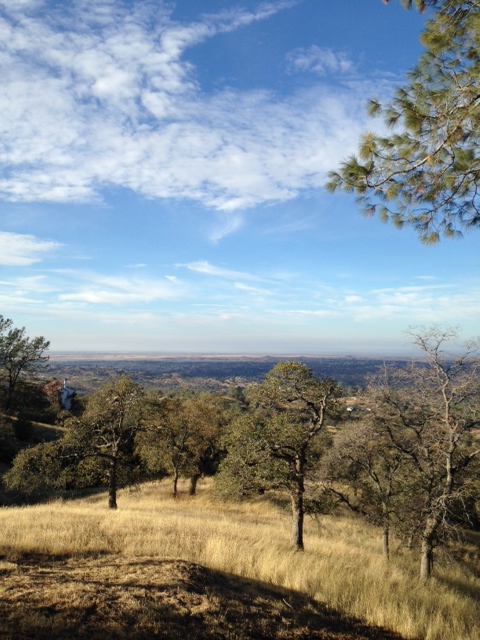
The fragrances of nutmeg, sage, cooked pumpkin and cranberries linger in the kitchen. I take my mug of tea on the deck. Here in my small, quiet corner of California the air is crisp but the sun warm on my skin. A squirrel digs frantically behind the rosemary bush and a family of quails scatter away. The native oaks haven’t lost their leaves yet and the big cloudless western sky spreads above my head.

This long Thanksgiving weekend foreshadows the upcoming holiday season when the happy padding of my children’s young feet in the hallways and stairs bring renewed energy to every room of the house.

The high-pitched voices of much younger kids playing in the neighborhood scare the humming birds hovering above the birdbath.

The turmoil of the world is distant and almost inexistent.

Last night as my family gave thanks around a dinner, we all knew we have a lot to be thankful for.

And today as I mentally check the leftovers for our extended family dinner, I think that the day after Thanksgiving is in some ways similar to the beginning of a new year.

Full of promise and anxiety.

The turkey was perfectly roasted and the purees smoothly mashed. The pumpkin pie was silky and the table beautiful under the candlelight.

The promise of a lovely family dinner has been reached.

But now I can’t help anxiety to hum its pessimistic note.

Where we will we be a year from today?

Will we be as healthy and as joyful?

I think of my writing, too.

What will I have accomplished a year from today?

Will I have honed my skills?

Exactly a year ago, I was releasing my novel Trapped in Paris and was having my first signing on Small Business Day at my local bookshop.

I had planned for another book in the fall.

But my unexpected summer trip to France to bury my father, the mourning of a great dad, and the regular complexity of life have derailed my plans. My next novel for middle graders will be released in the first part of 2014.

I have also doubted a lot while writing the first draft of a new novel.

Is this story really worth telling? Will I be able to create with words the scenes I have in mind? How can I write fresh metaphors and avoid clichés? How to make sure I’m not sending my own message through my fictional characters?

I have also been lazy.

This draft should be down by now.

I have also lived on a roller coaster with my memoir manuscript, which is currently circulating for a second round of reading in a California based publishing company.

My mug of tea is cold by now and I retrieve inside to brew a new pot.

I go through the pictures I took over the last two days.

This sky:
photo-42

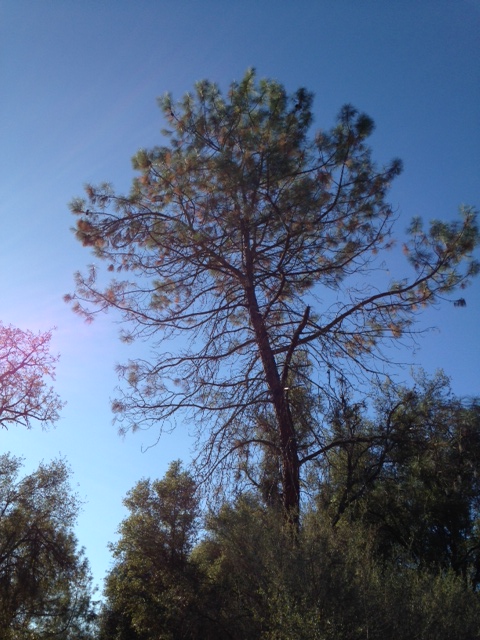
These trees:

photo-37

Calm fills me.

Somehow I will find a way to balance promise and anxiety.

More Than One Side to a Story

If you think that you’ve found a great idea for a novel, worked on a suspenseful plot, developed likeable characters, a unique setting, chances are that someone somewhere is writing a similar story.

It has happened to every writer. You submit a picture book manuscript to hear that the editor has just accepted a story just like yours, so she has to decline. You have the perfect topic for a biography and boom another writer has just been offered a contract for the same bio.

Until it happens to you, you feel for your writer friend who tell you how disappointed she is and you comfort her the best you can.

But when you read the brief synopsis of a YA fiction novel that sounds so familiar that you think this is my synopsis, you respond with your guts and clichés.

First you gasp. You have been hit in the stomach.

Then your heart starts pounding. Adrenaline rushes through your body.

Finally you start your grieving journey.

1-    Denial.

Impossible. It can’t be. It’s a bad dream.

2-    Anger.

You blame the writer who got your idea. Then you blame yourself. You’ve been lazy. Someone else has reached the final line while you plowed your way through your first draft.

3-    Doubt.

Have you lost your capacity to write anything original? Is your work useless? Are you done with writing?

4-    Acceptance.

Ideas are in the air, related to your period of time. Millions share your concerns. Millions think like you. So it makes perfect sense that for each idea you have someone else has the same.

5-    Hope.

The joy and suffering, the doubt and elation that you experienced and sustained you, day after day, while you wrote, why wouldn’t they come back? It is only up to you to make it happen. Again.

Of course it is easier to write about these strong emotions than it is to act.

On Wednesday as I was trying to figure out what to do with my story, I attended an author event.

Tim Egan, the author of seven books, came to the valley to talk about one of them: The Worst Hard Time: The Untold Story of Those Who Survived the Great American Dust Bowl.

The Dust Bowl has deep resonance here in Central California where thousands of Oklahoma people settled after leaving despair behind.

In addition to the historical importance of his book, Egan interested me as a writer. He said that he knew there was a story to write when he realized that American textbooks were covering the Dust Bowl tragedy in a short paragraph and always from the perspective of the people who fled.

So unlike Steinbeck who wrote about the ones who left, Egan chose to write about the ones who stayed behind and survived through the Dust Bowl.

There are at least two sides to the same story, he insisted, and it is necessary to tell the side less traveled. There are also different ways to tell the same story.

My novel idea was obviously not unique. Does it mean that there is only one story for one idea? I’m still saddened and undecided, but I have moved beyond my initial visceral reaction and I am contemplating the future of my draft.

Like roses come in different colors and shapes, offering a palette of fragances, stories based on the same idea have more than one side.

And there are also more than one way to tell them.

IMG_0100

Tuesday Blues

Is it because we had a three-day weekend, because the California sky was unusually gloomy, because I woke up too early – we had a power outage last night and our clocks got mixed up – or because I am putting the final touches to my middle grade novel?

I have felt restless and unproductive all day. Unable to write anything that could even remotely express my feelings.

Among the bloggers I read a few are poets. I admire their ability to convey in a few lines, sometimes a few words, their complex emotions, inaccessible dreams, inexplicable fears, invincible hope, and infinite love.

When I read their poems they become mine. Poets, better than fiction writers, are the spokesmen and spokeswomen of the collective human condition.

I used to write poems when I lived in France. I never wrote any since I moved to the US. Not even in French.

Tonight I found a poem by Georgia Douglas Johnson, which captures to the perfection my Tuesday blues. How can poems whisper so eloquently to our souls?

My Little Dreams

I’m folding up my little dreams

   Within my heart tonight,

And praying I may soon forget

   The torture of their sight.


For time’s deft fingers scroll my brow

   With fell relentless art—

I’m folding up my little dreams

   Tonight, within my heart.

Tomorrow is another day.

HPIM4013

Giving the Floor to Our Fiction Characters

Like most readers I love page-turner books. Action, adventure, mystery, and thriller books qualify. But slower paced books can be page-turners, too. They also tend to be my favorites.

What makes them so irresistible if it’s not a fast-paced plot?

Characters emotionally developed.

And this is what makes the work of a writer so interesting and so challenging.

Many characteristics define the people we like and don’t like, the people we love and hate. Complex back-stories make them who they are, and these combined multifaceted elements trigger the rich palette of feelings we have for them.

But unlike real people that we discover through many encounters, often years, and even a lifetime for family members or close friends for example, fictional characters live only through the span of a book.

Since I like children and YA fiction as much as adult fiction I almost always read two books at the same time.

I am currently reading the YA Out of the Easy by Ruta Sepetys – she wrote the beautiful Between Shades of Grey – and State of Wonder by Ann Patchett – she wrote several outstanding novels and two moving memoirs.

In both novels, the protagonists, who are female characters, jump from the page as if they were alive.

In about 350 pages for both novels, I fell and felt for seventeen-year-old Josie and forty-two-year-old Marina in the exact same way I fall and feel for real life people.

The writers aced this character development thing, I told myself, while painfully moving on with the draft of my own YA novel.

I realize that I am slowed down because I’m still developing my main character.

Initially I thought that I had introduced enough components to create a character as true to life as a real boy: I provided a physical description, other important characteristics such as family and friends relationships, a back-story, and other elements to situate seventeen-year-old Hugo in my story.

However, instinctively I knew I was missing something. I didn’t know what, although several times I thought I was close to discovering what was missing.

A writer works alone at character development, but once in a while a discussion with writing friends can help. The other day one of them read aloud my latest chapter. While she read a particular passage where Hugo is upset at the thought of his former girlfriend being with another guy, I thought that my description was a little too strong. But my friend commented in a different way and asked me if Hugo had a history of anger. I hadn’t considered this possibility although several elements of his back-story could easily justify anger.

My friend hadn’t asked me to depict my character one way or another, but one scene in my chapter had introduced the possibility of a teen boy who had anger issues. In fact, my friend reminded me of a previous scene when Hugo is also upset. As a reader she had understood that I was foreshadowing an essential aspect of Hugo’s personality.

Was I aware of this when I wrote? No.

Had Hugo tried to tell me more about him than what I wanted to know? Yes.

Was it why I knew I had to dig deeper into this boy? Yes.

Why didn’t I do it in the first place? Well…

I was too much in charge, too controlling, too tight. Ouch.

If you write fiction you’ve probably heard that the first draft takes you to unknown places, that the best way to deal with the first draft is to let your characters speak and act the way they wish.

Alexandria LaFaye, winner of the Scott O’Dell Award for her historical fiction novel Worth, told me once that her students regularly spotted her on campus talking and gesticulating as if in the midst of a lively conversation. Only to realize that she was alone.

“I wasn’t having a conversation,” she said. “My characters did.”

Her writing reflects her ability to let her characters become real to the point of talking through her mouth.

During this writing workshop she encouraged all participants (yes, me too) to leave our inhibitions at the door while we wrote the first draft of a story.

Let me tell you that it requires training.

After my meeting with my friend, I drove home. Since I was alone, I gave the floor to Hugo.

Man, he had a lot more on his mind than I had allowed him to say!

Back to draft mode.

HPIM3128

On Book Promotion and Manuscript Revision

So, as planned earlier this fall, Trapped in Paris and I were part of a Mystery and Imagination Book Festival.

As said earlier this month, I always go through a prep routine to get myself ready for this kind of events.

A few words about book events: even though all books are now available online, nothing beats a physical venue.

Meeting other readers and writers in person is a unique opportunity to share a common passion for words and stories, expand our network, renew established contacts, rekindle the writing flame, and yes put a face on online relationships.

As said earlier, there is always for me some apprehension.

Writing in a foreign language is hard enough, but being a speaker brings an unsettling mix of anticipation and anxiety to the nonnative.

As always, this book event was a mix of learning lessons and good time.

Since we were six writers, each of us was allowed twenty to twenty-five minutes. I came in fourth position and was relieved: I would take full advantage of my slot.

In reality I didn’t relax at all while listening to the first three authors.

I found them funny and clever. And they spoke fluent English. No way I could match them.

Yet in real reality I did relax. Especially toward the end.

Everyone was nice and smiling. They liked the cover of my book and Paris and everything French. And they even complimented me on my English.

The event was videotaped and a local TV channel stopped by to tape a segment.

When available I will lock myself in my den. I’m sure to draw valuable lessons from this new experience.

IMG_20130928_103159_784


Talking of experience, my editor has e-mailed me my middle grade novel edited and copy-edited. She worked as she did with Trapped in Paris, tracking changes on Word.

But when I worked on Trapped in Paris I did one huge mistake: I changed too much stuff from the story after the editor had finished her job. This mistake became a challenge for the formatting of the manuscript, which in turns is essential for the printing part.

My husband played a crucial role during this step. He’s supportive, resilient, clever, and skillful, but there are limits to everything and everyone. He remembers of our first partnership experience. Since I’d like to keep the partnership I must avoid a second round of similar mistakes.

This time I’m NOT rewriting big chunks of the novel. Promise.

But…

Although my novel is a work of fiction, I was inspired by the cultural, social and political backgrounds of the early 70s in France and the USA when I wrote this story. With my editor’s comments filling my screen, I need to double-check a few historical and cultural dates and accuracies, which I thought I had done. Like: when did Levi’s make jeans for women or how was the Coca-Cola logo in 1971?

See the importance of a second impartial pair of eyes?

So I get to read more about music, history and even clothes (oh lalala) from the 70s.

This is the fun part.

The less fun part: I should get rid of every adverb. We all know that an active verb is better than a verb plus an adverb. But that’s not my editor’s comment.

No, it’s a personal decision and based on a simple fact:  I just can’t understand where adverbs go.

Hey, in French I’m just fine, so it’s really this darned English language.

But writing is a journey they say.

Mine is only a bit bumpier. Yes, I know, obstacles make the trip more interesting.

That’s what I said at the book event. People liked it.

We always like it when others tell of their challenges; it helps us to surmount ours. And I’m totally convinced that mistakes and obstacles (ours and theirs) exist to make us better. Better people. Better writers.

So, once more, I’m tackling the embarrassing task: to agree on countless Accept Change offers from my editor.

Accept. Click. Accept. Click. Accept. Click…

I will deal with my husband later this week.